
by Maya Douglas on Nov 18, 2026

We identified a compromised e-commerce site serving trojanized copies of two of its own first-party JavaScript libraries. An obfuscated loader appended to jquery-migrate opens a WebSocket to qqqtan[.]com and executes any JavaScript the server sends back. A second trojanized file, jquery.validate, carries a ~201 KiB environment-keyed JavaScript bytecode VM. Clean and trojanized versions of each file are served alternately, and the server reports a 2023 timestamp for the trojanized loader, three years before its own C2 domain existed. Command-and-control sits behind Cloudflare.
Key Findings
Proven: shown directly by the evidence. Likely: the best explanation, not proven. Possible: consistent with the evidence, unconfirmed. Unknown: no evidence either way.
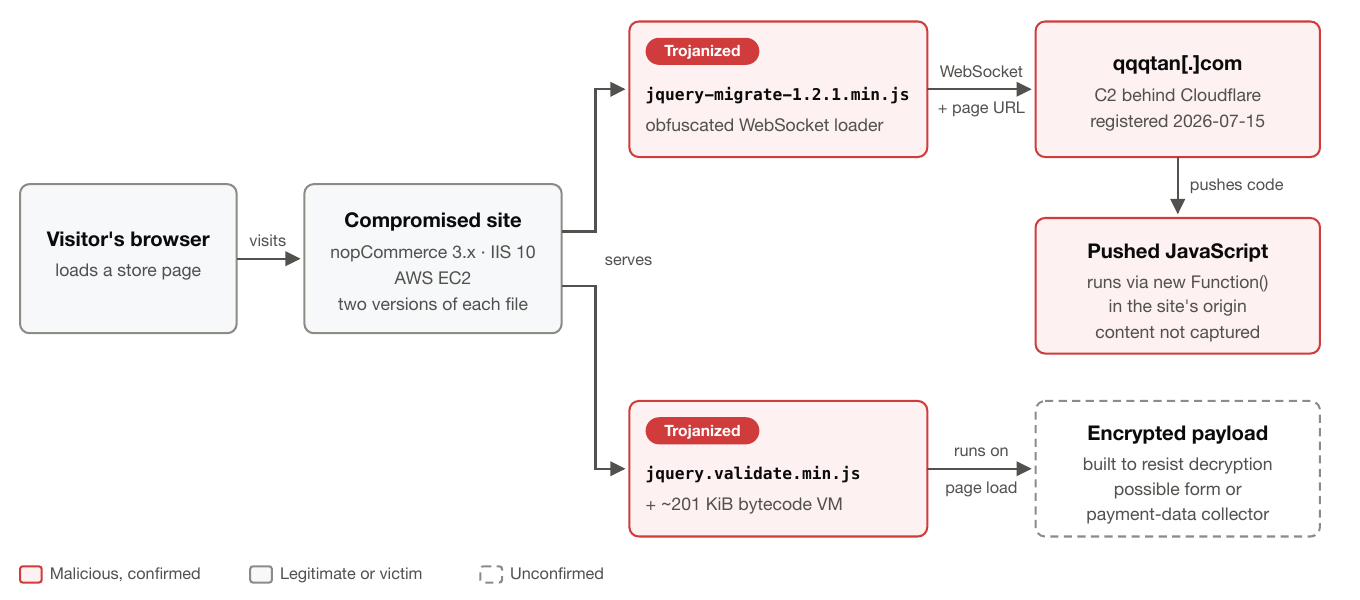
Figure 1. Infection chain. Both trojanized files come from the compromised site; the loader runs whatever qqqtan[.]com pushes. Dashed boxes are unconfirmed.
1. Loader: jquery-migrate-1.2.1.min.js
The stock jQuery Migrate 1.2.1 build (identical to the official release, ending }(jQuery,window);) is intact. Appended after it are 5,266 bytes of obfuscator.io output, bringing the file to 12,466 bytes. All decoding below is static. Nothing was executed.
Summary
|
Property |
Value |
|---|---|
|
Stock body |
jQuery Migrate 1.2.1, identical to the official release |
|
Appended code |
5,266 B, obfuscator.io |
|
String array |
_0x2ebf, 31 entries, each RC4-encrypted |
|
String decoder |
_0xc84b: lowercase-first custom base64, then RC4 under a per-call 4-character key |
|
Tamper check |
array rotated until an arithmetic checksum over ten decoded entries equals 0x847d6 |
|
Outer wrapper |
decode two strings → reverse the first → XOR with the second (gtag) → new Function(...)() |
|
Innermost layer |
C2 URL stored as an integer array, XOR 42 |
The Appended Code
Transcribed from urlscan's stored copy of the served file and split into four listings, otherwise unchanged. It is not byte-exact, so use the IOC table hashes rather than hashing this text.
String array. 31 entries, each custom-base64-encoded and RC4-encrypted under its own key. After the first call, _0x2ebf replaces itself with a function that returns the cached array.
String decoder. _0xc84b subtracts a base offset of 0x1e3, decodes the entry with the lowercase-first base64 alphabet, and RC4-decrypts it under the key passed with each call. Results are cached on the function itself under ZGbGSn, IRQHMF, OuobCA, nvbQgh and busYwA.
Rotation and checksum. Rotates the array one position at a time until ten decoded entries, passed through parseInt and combined in a fixed expression, equal 0x847d6. This listing and the next are one statement joined by a comma.
Final wrapper. Decodes entry 0x1f3 (key ]It3) as the payload and entry 0x1f7 (key vVe6) as the XOR key. It reverses the payload, XORs it character by character with the key, and runs the result with new Function.
Decoding
We decoded it statically, without running the code. Only one arrangement of the hidden strings passes the obfuscator’s own checksum, so the decode confirms itself.
The XOR key is gtag, which reads like Google's analytics tag. Here is the decoded second stage with one statement per line:
ftb XOR 42 decodes to wss://qqqtan.com/common?source=.
What It Gives the Operator
The source parameter tells the C2 which page each visitor is on, query string included. Whatever comes back runs as the compromised site: it can read and rewrite the page, read form fields as they are filled in, read cookies not marked HttpOnly, and make requests with the visitor's session. The file only ever holds the loader, so a static scan of the site won't find the operator's code. We did not capture any pushed content.
2. Payload: jquery.validate.min.js
The stock jQuery Validation 1.11.1 build (identical to the official release, plus Microsoft's NuGet license comment at the top) ends normally at validateDelegate:function(e,i,s){…}})}(jQuery);. Appended after it is ~201.4 KiB of JavaScript virtual machine. An interpreter (vmM_eb7aa1) executes encrypted bytecode stored as a custom-alphabet base64 string, and keeps its state on a global object (vmZ_9f2f97).
Summary
|
Property |
Value |
|---|---|
|
Stock body |
jQuery Validation 1.11.1, identical to the official release plus Microsoft's NuGet license comment |
|
Appended code |
~201.4 KiB bytecode VM; file total 222.8 KiB |
|
Bytecode alphabet |
6Ed+JGzmP7Th5pQb1nAs3jx2KLciCwvatMHyfFqoNZlIOS8Ugku/D9rXW4BYeRV0 |
|
Language markers |
globalThis ×3, BigInt literals ×7, async generator ×1, new.target ×19 |
|
Status |
Encrypted; needs dynamic analysis in an instrumented browser |
The language markers settle the tampering question by themselves. globalThis and BigInt are ES2020 features, and every marker in the table postdates the library's 2013 release.
Where the Library Ends and the VM Begins
The stock library's last statement is intact:
The appended code starts with a semicolon so it parses cleanly after that statement. It finds the global object, creates vmZ_9f2f97 on it to hold VM state, and defines the interpreter vmM_eb7aa1:
Self-Hash Protection and Bytecode
The function that holds the bytecode binds its own toString to the native Function.prototype.toString. An analyst who hooks toString cannot feed it modified source when it hashes itself. The encrypted bytecode follows as base64 strings in a custom alphabet:
Environment Probes
The decryption key is derived from that self-hash and from the runtime. The VM checks for Node's process and require, then for browser objects, each check inside its own try/catch:
It also decodes a list of edge-case two-byte sequences with TextDecoder in euc-kr, shift_jis and big5. A runtime that lacks these encodings, or handles the edge cases differently, produces different results. Timing feeds in as well. Editing the code, running it under Node, or single-stepping it in a debugger all change at least one input.
Crash Trap
A helper fills an array with 0x27bea1fb (666,804,731) strings. That is enough to exhaust memory and stall or kill whatever tab or analysis process runs it.
Exit: Globals and Entry Call
The appended code ends by exposing browser globals to the VM through getters and setters on vmZ_9f2f97, then starting the interpreter. The last two globals it exposes are FormData and File:
Probable Purpose
The VM references window, document, Element, navigator, fetch, FormData, File, URLSearchParams, btoa, encodeURIComponent and TextEncoder. That set covers reading the page, packaging form data, encoding it and sending it out. On an e-commerce site, that fits a form or payment-data collector. Confirming it needs the VM run in an instrumented browser, which this report does not include.
3. What the Server Serves
Three scans from three vantage points over nine hours returned two distinct bodies for each file.
Two Versions of Each File
When IIS serves a static file itself, the ETag encodes the file's last-write time as eight hex bytes without zero padding. We try every split into eight bytes and keep the one within 1.5 seconds of the Last-Modified header, which recovers the sub-second precision that header drops (decoder in the appendix).
|
File |
Version |
SHA-256 |
ETag |
Decoded timestamp (UTC) |
|---|---|---|---|---|
|
migrate |
trojanized |
d4c29296… |
"0fa6060f3a7d91:0" |
2023-06-26 05:59:32.0000000 |
|
migrate |
clean |
b3dd0087… |
"03af7352aa7d91:0" |
2023-06-25 05:59:32.0000000 |
|
validate |
trojanized |
71ecc4bd… |
"aee449452aa7d91:0" |
2023-06-25 05:59:57.7075886 |
|
validate |
clean |
4d4d42f6… |
"80ecdd442aa7d91:0" |
2023-06-25 05:59:57.0000000 |
|
jquery-ui (reference) |
clean |
n/a |
"e72eb3452aa7d91:0" |
2023-06-25 05:59:58.3976167 |
Each body kept one fixed ETag across every scan, where a file rewritten on the fly would show one ETag with changing content. Two versions of each file are being served, from one or more back ends.
What Each Scan Received
|
Scan (UTC) |
Source |
jquery-migrate |
jquery.validate |
|---|---|---|---|
|
2026-10-29 20:06 |
Third party, Singapore |
trojanized |
clean |
|
2026-10-30 00:46 |
RADICL, Germany |
trojanized |
trojanized |
|
2026-10-30 05:25 |
RADICL (private) |
clean |
trojanized |
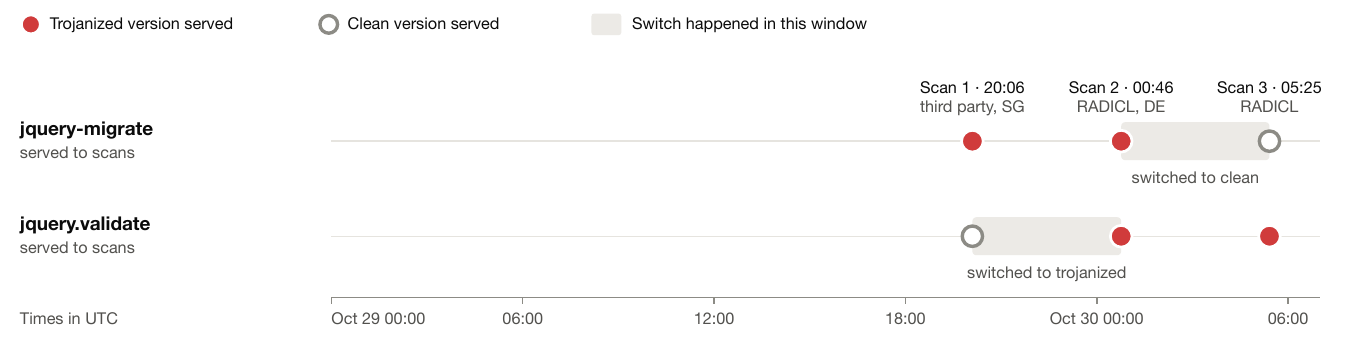
Figure 2. Which version of each file the server gave each scan (UTC).
The section 4 workstation ran the trojanized migrate on all three of its visits, since each one connected to qqqtan, but it probably downloaded the file only once. The site's scripts carry Cache-Control: max-age=604800, which lets a browser reuse its copy for seven days, and all three visits fell inside that window. We saw that header on jquery.validate and jquery-ui, not on migrate. urlscan starts each scan with an empty cache, so the differences between scans did come from the server.
jquery.validate went from clean to trojanized between 20:06 and 00:46. jquery-migrate went from trojanized to clean between 00:46 and 05:25. Several explanations fit:
|
Explanation |
How it would produce this pattern |
|---|---|
|
Attacker-controlled serving |
The attacker swaps files over time, or serves versions by visitor or location |
|
Web farm |
One IIS node is compromised and another is clean or partly restored; sticky sessions (AWSALB, ARRAffinity) or geo-DNS decide who reaches which |
|
Caching |
A CDN or reverse proxy keeps serving an old version, ETag included, after the origin changes |
|
Remediation |
An administrator restored jquery-migrate from backup, which would also explain its whole-second 2023 timestamp |
|
Malicious IIS module |
A module that injects content can set any ETag or Last-Modified, so a fixed ETag does not prove a file on disk |
A single EC2 address makes an AWS load balancer less likely but does not rule out a web farm behind it. Per-scan IPs, timed fetches from one vantage point, and the workstation's Chrome cache and cookies would narrow it down. The owner's IIS configuration and logs would settle it.
Timestamp Mismatch
The server dates the trojanized migrate 2023-06-26 05:59:32.0000000, exactly 24 hours after the clean copy. Its payload references qqqtan[.]com, registered 2026-07-15 with no certificates or web archive captures before then, so the timestamp does not reflect when the content was written. Timestamp-preserving tools (rsync -t, robocopy, zip or Web Deploy packages, FTP MFMT) could have carried the date over, so this does not prove it was set by hand. The one-day offset still points to the attacker or their tooling.
The trojanized validate's timestamp, 2023-06-25 05:59:57.7075886, falls inside the site's original deployment burst, and its content does not rule out a 2023 date. Its sub-second value resembles jquery-ui's original write, while the clean validate's is a whole second, so the clean copies may be the later ones, for example from a restore. We have not shown the validate timestamp is wrong, and we do not assume the clean copies are the originals.
4. Observed on an Endpoint
RADICL first saw this activity as a threat-intel domain match on qqqtan[.]com from a customer workstation's Chrome network-service process. The workstation visited the compromised site three times.
|
Visit |
Connection |
Tie to the compromised site |
|---|---|---|
|
1 |
104.21.5[.]16:443 |
DNS for the site and qqqtan ~1 s apart (inferred) |
|
2 |
172.67.132[.]188:443 |
Same; Chrome had relaunched after an auto-update and restored the open tab (inferred) |
|
3 |
172.67.132[.]188:443 |
NEL policy row recorded 151 ms after the connection (proven) |
Visit 2 needed no navigation: Chrome relaunched after an update and restored the tab. Each visit made exactly one connection to qqqtan's Cloudflare edge, with no reconnects or beaconing.
NEL: Proof of a C2 Response Inside the Page
Cloudflare adds a Network Error Logging (NEL) header to its responses. Chrome stores the resulting policy in the profile's Network\Reporting and NEL database, keyed by a network isolation key (NIK) that names the top-frame site. This workstation's store held one row for qqqtan:
|
Field |
Value |
|---|---|
|
Origin |
wss://qqqtan[.]com:443 |
|
Received IP |
172.67.132[.]188 |
|
Report group |
cf-nel |
|
NIK top-frame site |
the compromised site |
|
Expires |
7 days after last access (Cloudflare's max_age) |
Chrome writes that row only after receiving a response from qqqtan, and the NIK ties it to the compromised site's page, which proves visit 3. Only the latest policy is kept, so visits 1 and 2 rest on DNS adjacency. The row does not show whether the WebSocket upgrade succeeded or what was pushed, and the cache files were locked at collection time.
What EDR Can and Cannot See
Pushed JavaScript runs inside the browser, out of EDR's view. EDR showed nothing after any visit: no unexpected downloads, LOLBins or persistence. Browser history has no login, account, cart or checkout pages on the site, though that check does not cover fake overlays or other devices. No other customer host or RADICL tenant contacted qqqtan.
5. Infrastructure
qqqtan[.]com was registered on 2026-07-15 through Hostinger with Cloudflare nameservers. It resolves to shared Cloudflare edge addresses (172.67.132[.]188, 104.21.5[.]16), hiding its origin. A plain HTTPS request returns an empty Apache/2.4.63 (Ubuntu) "Index of /" page. At analysis time, 2 of 92 VirusTotal engines flagged it and CrowdStrike Intelligence rated it high-confidence malicious. The earliest third-party sighting we found was 2026-10-21.
The compromised site, a legitimate business running nopCommerce 3.x on IIS 10 and AWS EC2, is a victim and is not named here.
6. Detection
Endpoint. Alert on any process resolving or connecting to qqqtan[.]com. Pushed code running in the browser is invisible to EDR.
Browser forensics. Check each Chrome profile's Reporting and NEL database for a nel_policies row with origin_host qqqtan.com. Its NIK names the page the request came from, and the policy expires seven days after last use. The cache entry for the loader shows when it was fetched and which ETag it received. Chrome locks its cache while running, so collect with the browser fully closed. An infected copy keeps running from cache for up to seven days, so clear the cache after collection.
Network. Block qqqtan[.]com at DNS or proxy. Do not block its IP addresses: they are shared Cloudflare edge addresses that also front unrelated sites.
Site owners.
Indicators of Compromise
Files
|
ID |
SHA-256 |
Size |
Role |
|---|---|---|---|
|
JS-MIG-T |
d4c29296718f97016df0b3300abec294b5aef0e17f2daf9fa6e0d4e1cc759559 |
12,466 B |
Trojanized jquery-migrate-1.2.1.min.js (WebSocket loader) |
|
JS-VAL-T |
71ecc4bdb05227fe0aa52b9cd580e246b43e004b6a6e230820512e10132153b4 |
222.8 KiB |
Trojanized jquery.validate.min.js (bytecode VM) |
Network
|
Indicator |
Type |
|---|---|
|
qqqtan[.]com |
C2 |
|
wss[:]//qqqtan[.]com/common?source= |
C2 URL |
|
172.67.132[.]188 |
Cloudflare edge, shared (do not block) |
|
104.21.5[.]16 |
Cloudflare edge, shared (do not block) |
Host and Server Artifacts
|
Artifact |
Indicator |
Where to find it |
|---|---|---|
|
Chrome NEL policy |
origin wss://qqqtan[.]com:443 |
%LOCALAPPDATA%\Google\Chrome\User Data\<profile>\Network\Reporting and NEL, table nel_policies |
|
IIS ETag, trojanized migrate |
"0fa6060f3a7d91:0" |
HTTP response header from the server |
|
IIS ETag, trojanized validate |
"aee449452aa7d91:0" |
HTTP response header from the server |
Code Strings
|
String |
Where |
|---|---|
|
_0x2ebf, 0x847d6, ZGbGSn, IRQHMF, nvbQgh |
Loader file (obfuscator identifiers; build-specific) |
|
gtag (XOR key), window.ww = new WebSocket |
Loader, decoded at runtime only |
|
vmZ_9f2f97, vmM_eb7aa1 |
VM file (build-specific) |
YARA
Both rules key on identifiers the obfuscators generate per build. They will catch these files and close copies, but a rebuild will change them.
Appendix: IIS ETag Decoder
Recovers the full-precision last-write timestamp from an IIS static-file ETag, using the response's Last-Modified header to resolve the ambiguous hex.

No Comments Yet
Let us know what you think