
Phishing Attack Prevention

Modern phishing attacks bypass basic email filters. Move beyond annual checkbox training with phishing simulations modeled after real-world campaigns.

RADICL’s continuous security awareness is guided by Virtual Security Operations Center (vSOC) experts in order to keep regulated growing businesses clear of cyberthreats.

Talk to a Specialist Learn About Our Platform
Div Line_Desktop
Div Line_Mobile

Common Types of Phishing Attacks

Spear Phishing

Spear Phishing

Personalized emails targeting specific employees using trusted names, internal details, or business context.

Whaling

Whaling

Executive-focused attacks targeting founders, CEOs, and senior leaders with access to sensitive systems and funds.

Smishing & Vishing

Smishing & Vishing

Text messages and phone calls designed to steal credentials, bypass controls, or impersonate trusted contacts.

AI-Generated Phishing

AI-Generated Phishing

Attackers using AI to create legitimate-looking messages, removing traditional warning signs like bad grammar.
Phishing

Why Basic Email Defenses Fail Against Modern Phishing

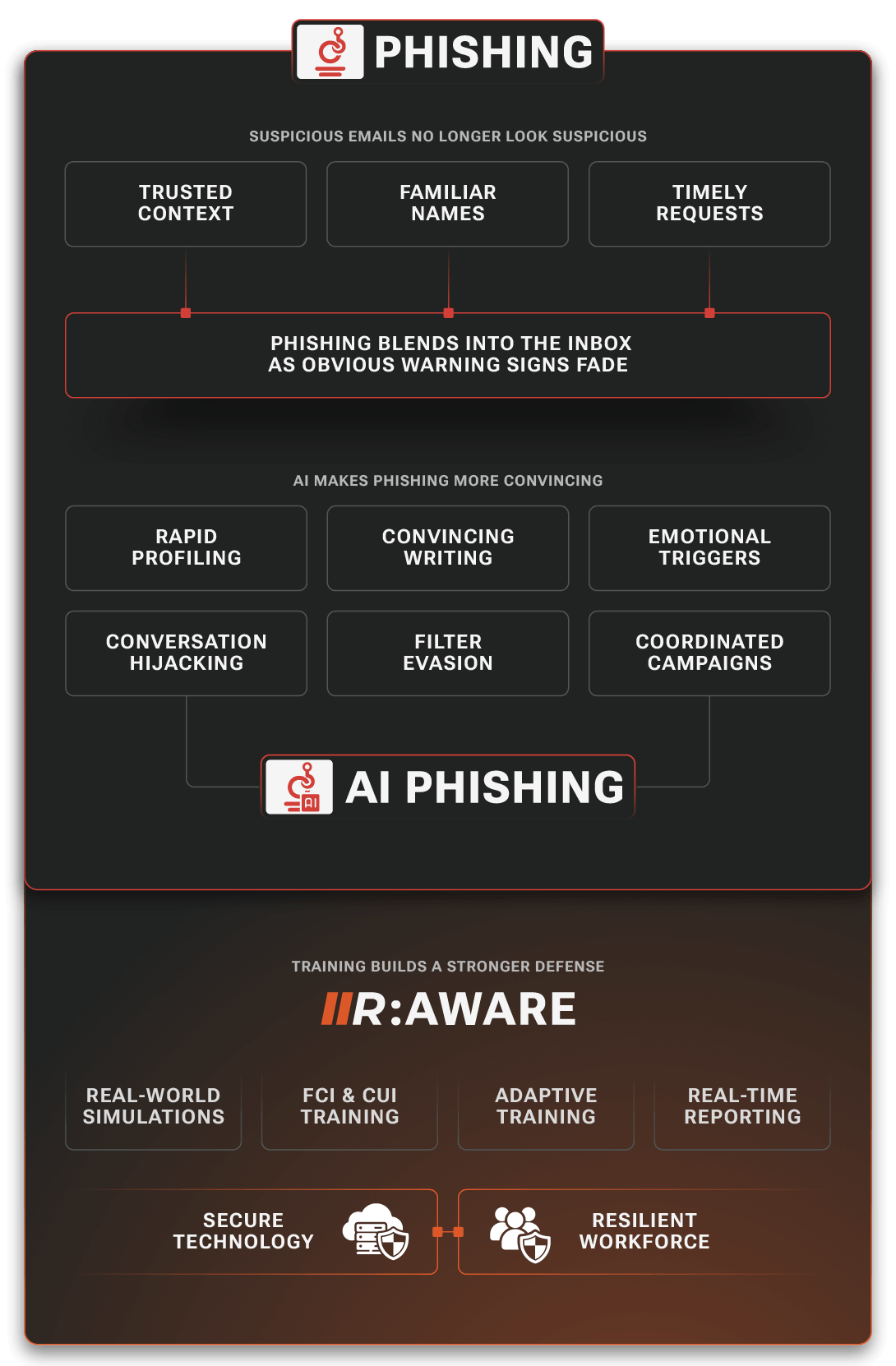
Obvious warning signs that once made phishing easy to spot have largely disappeared.

Today's attackers use AI to create convincing spear-phishing messages. They imitate executives, coworkers, vendors, and customers.

Email filtering still plays an important role. Some suspicious messages still reach the inbox, especially when they use familiar names, timely requests, or trusted business context.

Ongoing phishing awareness training gives employees more practice identifying suspicious messages. Continuous testing and reinforcement also help organizations see where users need more support.

For growing businesses, this creates a more resilient team and a stronger record of security awareness activity.

Phishing

The True Cost of a Phishing Breach for Regulated Industries

For regulated organizations, a successful phishing attack can trigger consequences that affect the entire organization.

Ransomware & Operational Disruption

Ransomware & Operational Disruption

A compromised account can become the entry point for ransomware, downtime, and costly recovery efforts.

CUI Exposure

CUI Exposure

Phishing attacks often target credentials that provide access to Controlled Unclassified Information and sensitive data.

Compliance Risk

Compliance Risk

Security incidents can create audit findings, documentation gaps, and challenges in meeting compliance requirements.

Contract & Revenue Impact

Contract & Revenue Impact

A breach can jeopardize DoD contracts, prime contractor relationships, and future business opportunities.

Div Line_Desktop
Div Line_Mobile

How RADICL Helps Reduce Phishing Risk

View Pricing How We Compare

Beyond the Inbox: Layered Protection Against Phishing

RADICL helps organizations detect, contain, and investigate phishing threats before they become major incidents.

Managed Detection & Response (MDR)

Managed Detection & Response (MDR)

Detects suspicious endpoint activity and helps stop attacks before they spread across the environment.

Human-Led vSOC

Human-Led vSOC

Security analysts investigate alerts, validate threats, and guide response efforts when suspicious behavior is detected.

Managed Log Analytics (MLA)

Managed Log Analytics (MLA)

Centralizes and retains log data to support RADICL in investigations, incident visibility, and compliance evidence guidance needs.

Icon-89

Incident Visibility

Understand what happened, which systems were affected, and what data may have been accessed.

Compliance Support

Compliance Support

Maintain the documentation and audit trail required for CMMC, NIST 800-171, and other regulatory frameworks.

No Phishing

Phishing awareness reduces risk

Defense-in-depth helps contain the attacks that get through.

Reduce Phishing Risk. Support Compliance Readiness.

Let’s talk now

Frequently Asked Questions

What Is the Difference Between Phishing and Business Email Compromise (BEC)?

Phishing is a broad category of attacks that uses fraudulent emails, texts, or messages to steal information or gain access. Business Email Compromise (BEC) is a more targeted phishing attack that impersonates trusted executives, vendors, or partners to trick employees into transferring funds, sharing sensitive data, or changing payment information.

How Often Should We Run Phishing Simulations?

Most cybersecurity experts recommend running phishing simulations year-round rather than relying on annual training exercises. Frequent simulations help organizations identify vulnerable users, reinforce security awareness, and measure improvement as phishing tactics evolve.

Does RADICL’s Training Satisfy CMMC Awareness Requirements?

RADICL's Managed Security Awareness (MSA) program supports CMMC and NIST 800-171 awareness and training requirements. Organizations receive ongoing training, phishing simulations, reporting, and documentation. These, in turn, help demonstrate compliance and provide evidence for assessments and audits.