





















Cybersecurity for Critical Infrastructure
Ensure Operational Resilience and NIST Compliance
Why critical infrastructure gets targeted
Nation-state adversaries and ransomware syndicates pursue critical infrastructure because downtime translates directly to economic disruption and public safety risks. A single incident can lead to halted operations, severe regulatory penalties, and loss of public trust, especially when overstretched IT teams and legacy systems slow down detection and response.
Operational Disruption
Adversaries know that halting energy, water, or transportation systems forces urgent, high-stakes responses.

IT/OT Convergence
As operational technology connects to IT networks, the attack surface expands, creating new vulnerabilities.

Uptime is Critical
Incidents aren't just IT tickets, they are immediate threats to service delivery and community safety.

Lean Teams + Tool Sprawl
Attackers bet your resource-constrained team will detect late, investigate slowly, and lack the logs to prove remediation.

Top pain points for critical infrastructure operators
IT/OT Convergence Risks
Bridging legacy operational technology with modern IT networks creates blind spots and expands your attack surface.
NIST Compliance Proof Burden
Protecting systems is only half the job; you also need centralized, searchable log evidence to satisfy NIST auditors.
Legacy and Mixed Environments
Older endpoints, industrial control systems, and hybrid stacks complicate standard security monitoring.
Supply Chain Vulnerabilities
Interconnected vendors and third-party software introduce risks that require continuous monitoring to detect.
Alert and Vulnerability Overload
Too much noise leads to slow triage, delayed patching of critical systems, and recurring audit findings.
Resource-Constrained IT
Balancing daily network uptime with complex threat hunting and compliance reporting is impossible without the right tools.
How RADICL works
RADICL turns security into an execution model for regulated industries: ingest and analyze the right signals, triage and investigate what’s real, then coordinate response and track remediation to verified closure so you can prove outcomes for NIST expectations.
The hardest cybersecurity controls for critical infrastructure
The framework for improving critical infrastructure cybersecurity converges on the same operational controls—the ones that are hardest to implement without dedicated security staff. RADICL is built to operationalize these controls continuously.
Log Management
Collect, normalize, retain (1-year archive), and make logs searchable for NIST compliance evidence and rapid investigation.

Incident Response
24/7 coverage, coordinated execution, and documented outcomes (including testing/tabletops where applicable).
Vulnerability Management
Prioritize what matters, drive remediation, and verify closure.

Security Awareness
Reduce human-driven risk with ongoing training and reporting.

Options for critical infrastructure operators
Not every organization should take the same approach on day one, because your network architecture, legacy systems, and operational constraints differ.
Compliance Evidence Path
You already operate serious security controls under NERC CIP, TSA directives, or internal mandates. Auditors want centralized, searchable log evidence you can't readily produce. This path focuses on log collection, normalization, retention, and audit-ready documentation without rebuilding your security program from scratch.
Best for: Organizations with mature operational security practices that are failing audits on proof, not on controls.
OT Boundary Path
Your IT environment has reasonable coverage, but the convergence zone between operational technology and corporate networks is a blind spot, no visibility, no telemetry, no response playbook. This path establishes monitoring and response capability at the IT/OT boundary without requiring agents on control systems or disrupting operational workflows.
Best for: Organizations where legacy OT systems can't support endpoint agents but the network boundary can be instrumented.
Scoped Critical Systems Path
A defined-scope approach where you identify your highest-criticality operational systems and the networks they touch, then focus security operations and compliance evidence strictly on that environment.
Best for: Teams that can cleanly segment IT from OT or isolate critical operational enclaves from the broader network.
Our Solutions
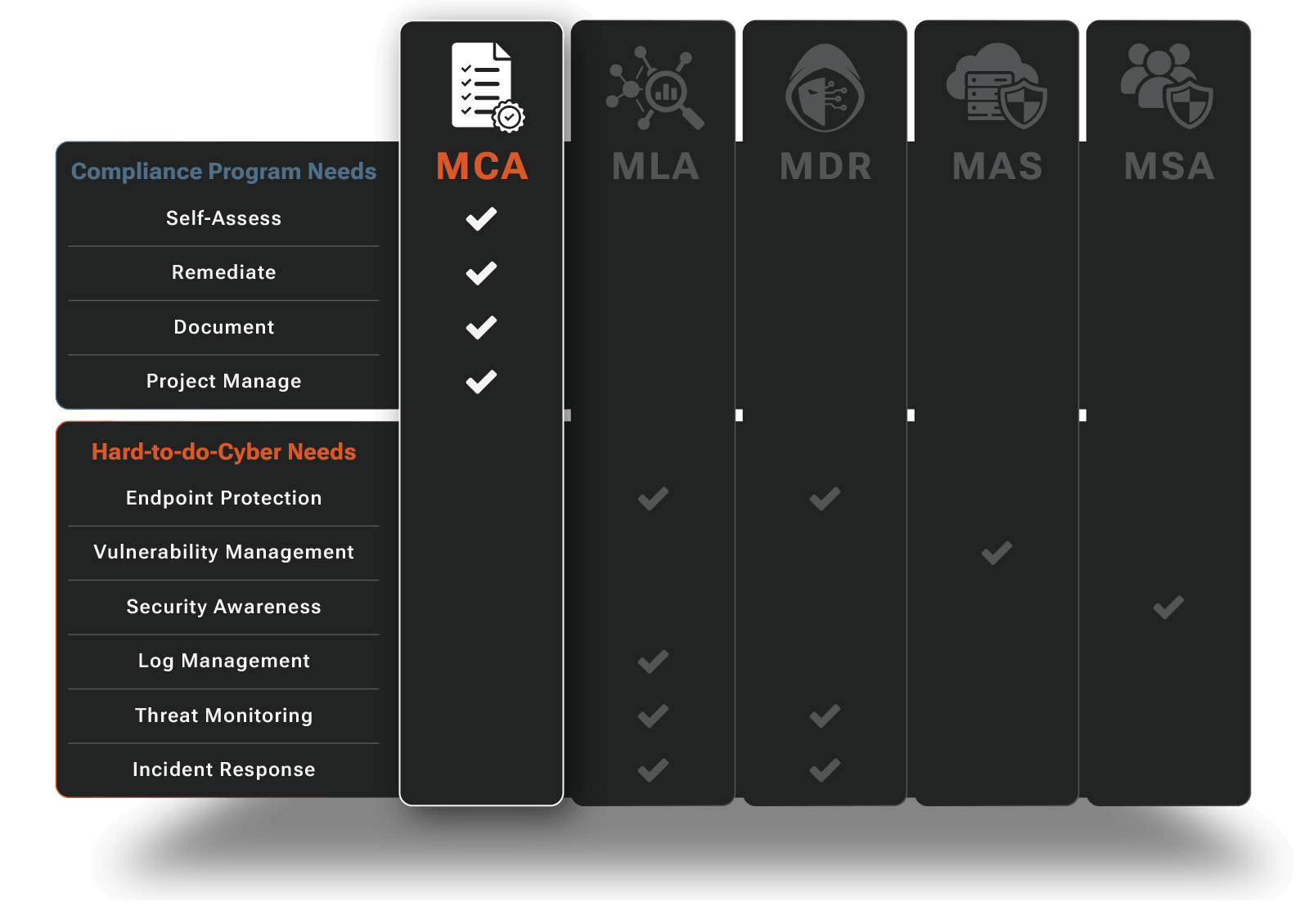
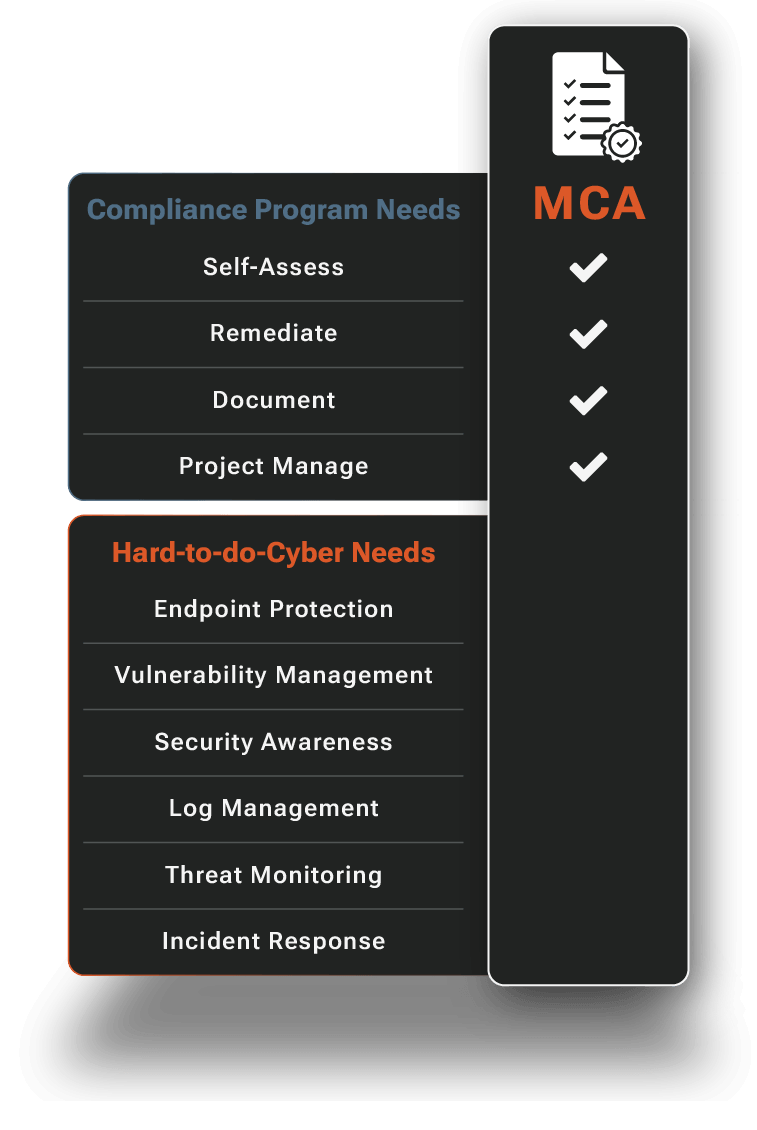
Managed Compliance Adherence for CMMC and NIST
CMMC and NIST 800‑171 (and similar frameworks) are now a cost of doing business. We keep the cost low. Our Managed Compliance Adherence expertly guides and manages your compliance journey. Our compliance experts combined with agentic automation fast track readiness and reduce audit anxiety.
- Self-Assessments Guided and Made Easy
- CMMC and NIST Adherence Gaps Quickly Closed
- Audit Trail and Evidence Capture
- Compliance Posture Clarity
- External Audit Preparedness & Efficiency
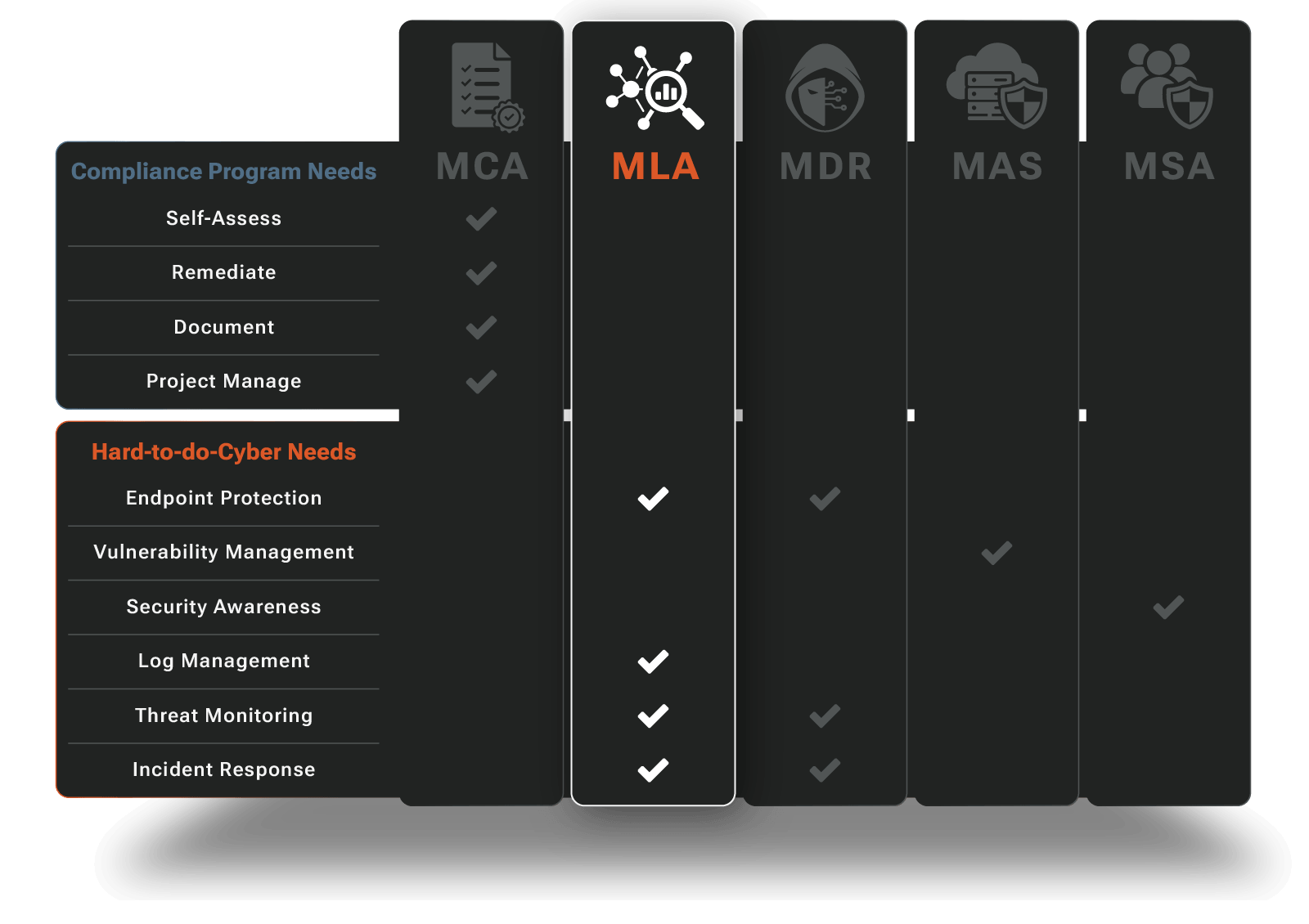
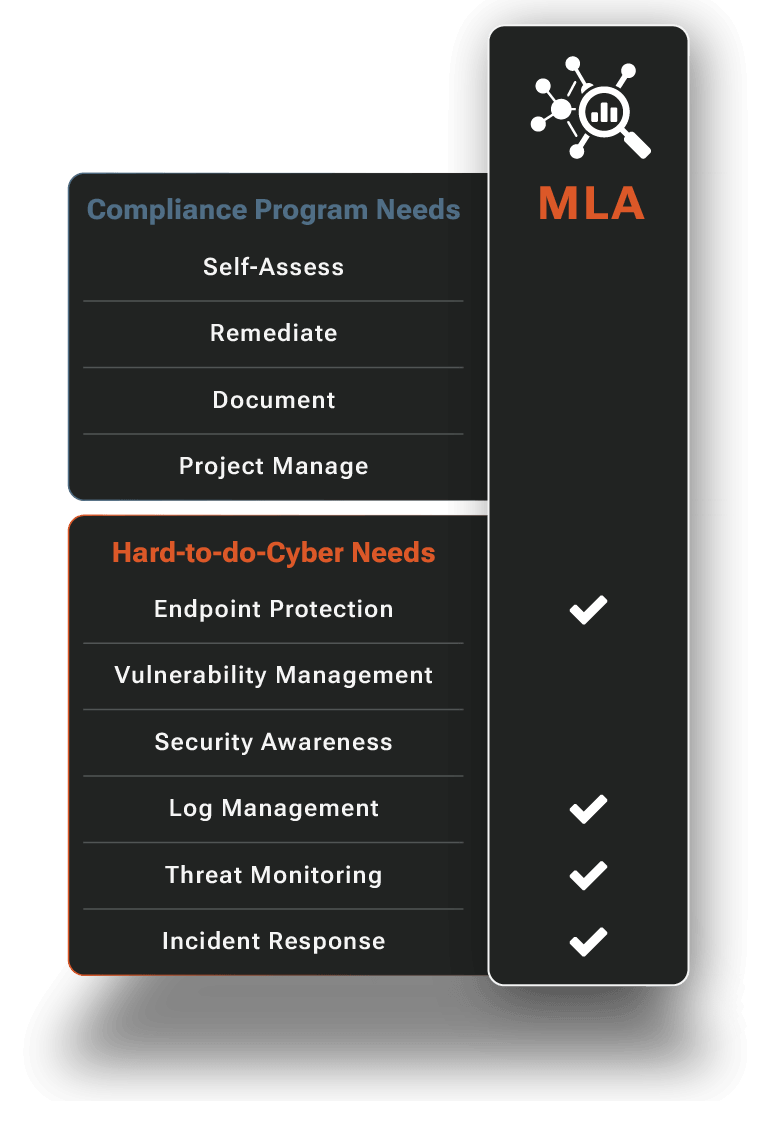
Managed Log Analytics
Investigations and audits require comprehensive visibility, but aggregating logs across your entire environment can be complex and expensive. Not with us.
We handle the entire log management lifecycle, from collection and normalization to long-term retention and searchable investigation capabilities. Our platform gives you the log foundation needed for effective detection & response while meeting strict compliance requirements.
- 14 or 90-Day Velocity Search + 1-Year Archive
- AI-Assisted Natural Language Search
- Hunt UX with vSOC Incident Escalation
- On-Demand Compliance Evidence Export
- vSOC-Managed Ingestion & Health Monitoring
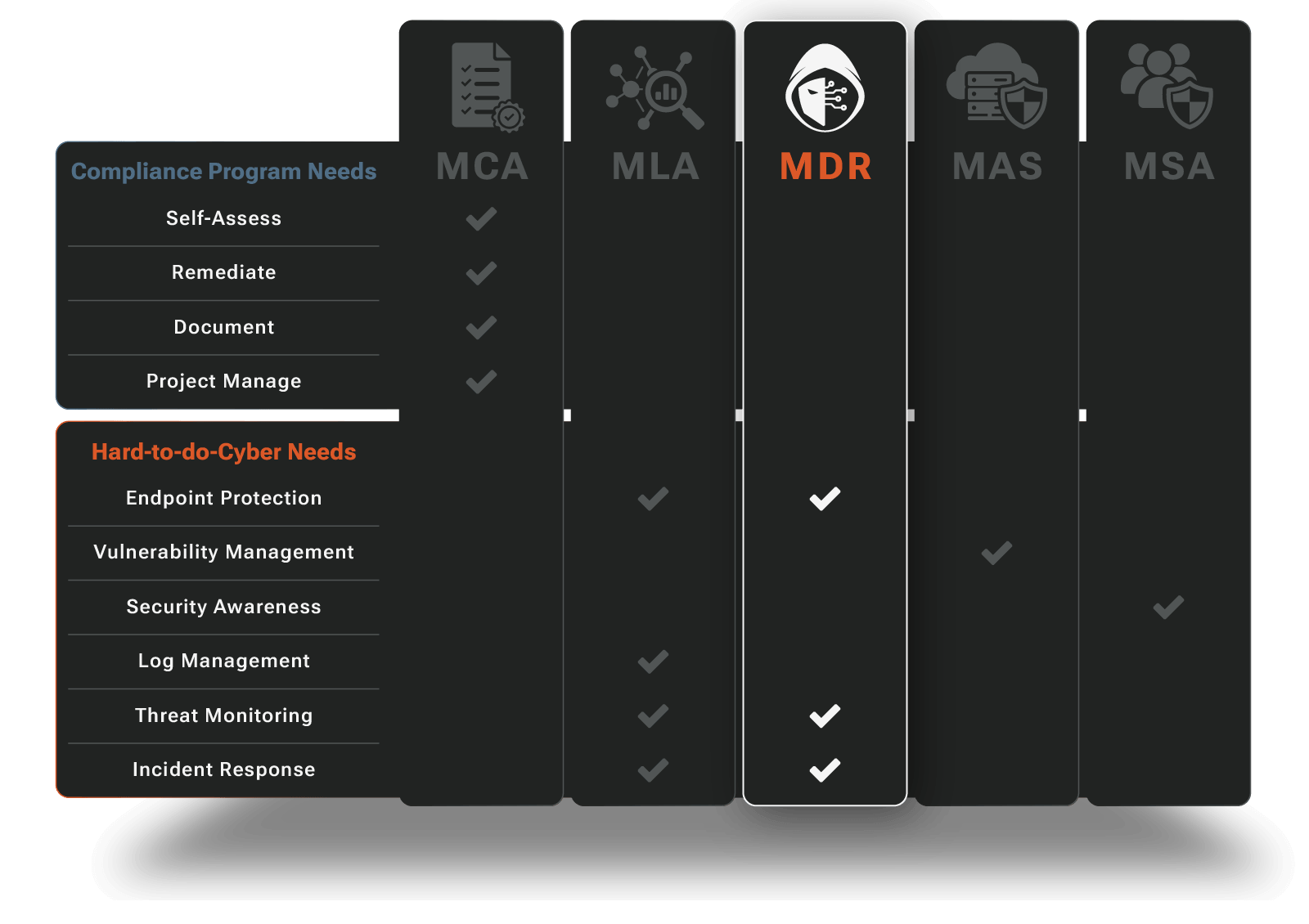
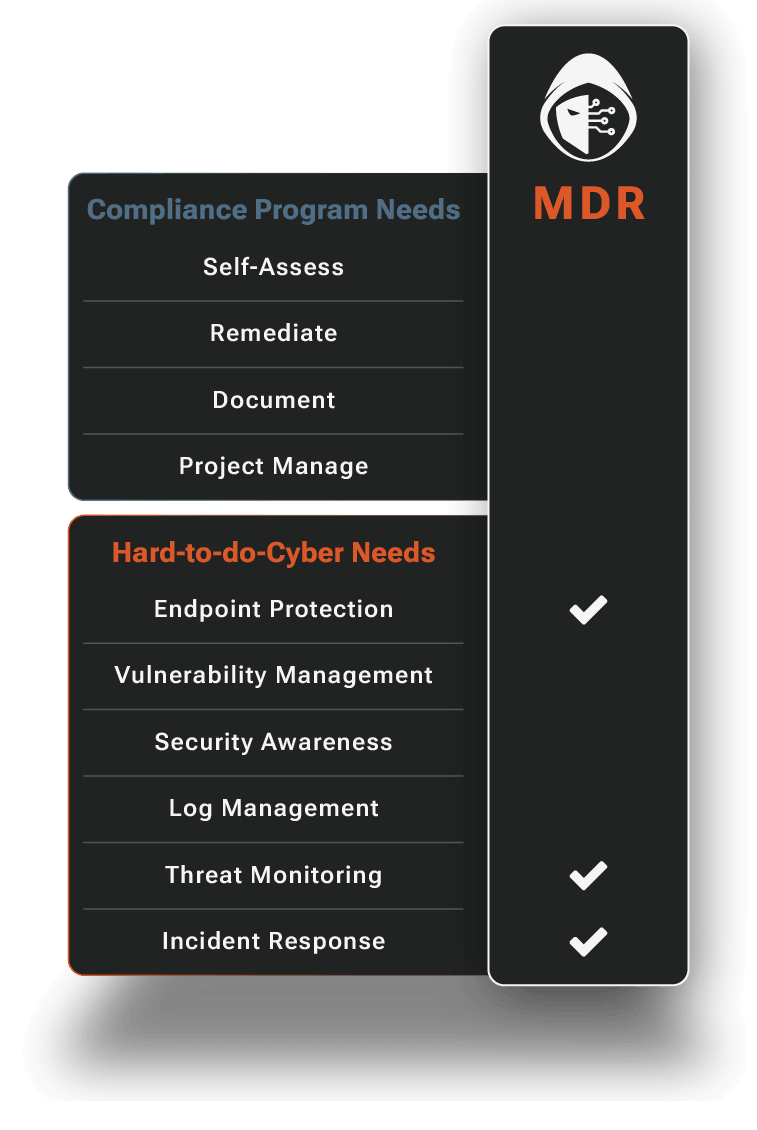
Managed Detection
and Response
Advanced endpoint protection, military-grade threat hunting, and 24/7 incident response ensure your company is safe from ransomware, data theft, financial fraud, and other high-impact cyber risks while supporting CMMC and NIST 800‑171 compliance.
- Endpoints and Servers Protected
- Evasive & Embedded Threats Detected and Stopped
- 24/7 Security Operations Has Your Back
- Incidents Managed End-to-End
- Virtual CISO By Your Side
MDR: Endpoint
MDR: Endpoint is the foundation of our MDR offering. We deploy, optimize, and maintain leading EDR technologies (for example, CrowdStrike, SentinelOne, and Microsoft Defender) across your laptops, workstations, and server infrastructure. We deploy custom detection analytics to spot threats out-of-the box EDR miss.
MDR: Identity
With MDR: Identity, we ingest and analyze data from Identity and user activity data sources like Microsoft 365 and Google Workspace. We monitor authentication activity, access to sensitive data and files, and email behavior to detect account takeover, inbox compromise, and data exfiltration.
MDR: Network
MDR: Network collects alarms and threat data from physical, wireless and cloud network infrastructure. We correlate this with endpoint and identity telemetry to fully investigate suspicious behavior and provide defense‑in‑depth coverage.
How RADICL Detects and Responds
Below is a closer look at our Managed Detection and Response (MDR) operations. This is how we turn signals into 24/7 investigations, containment, and tracked remediation.
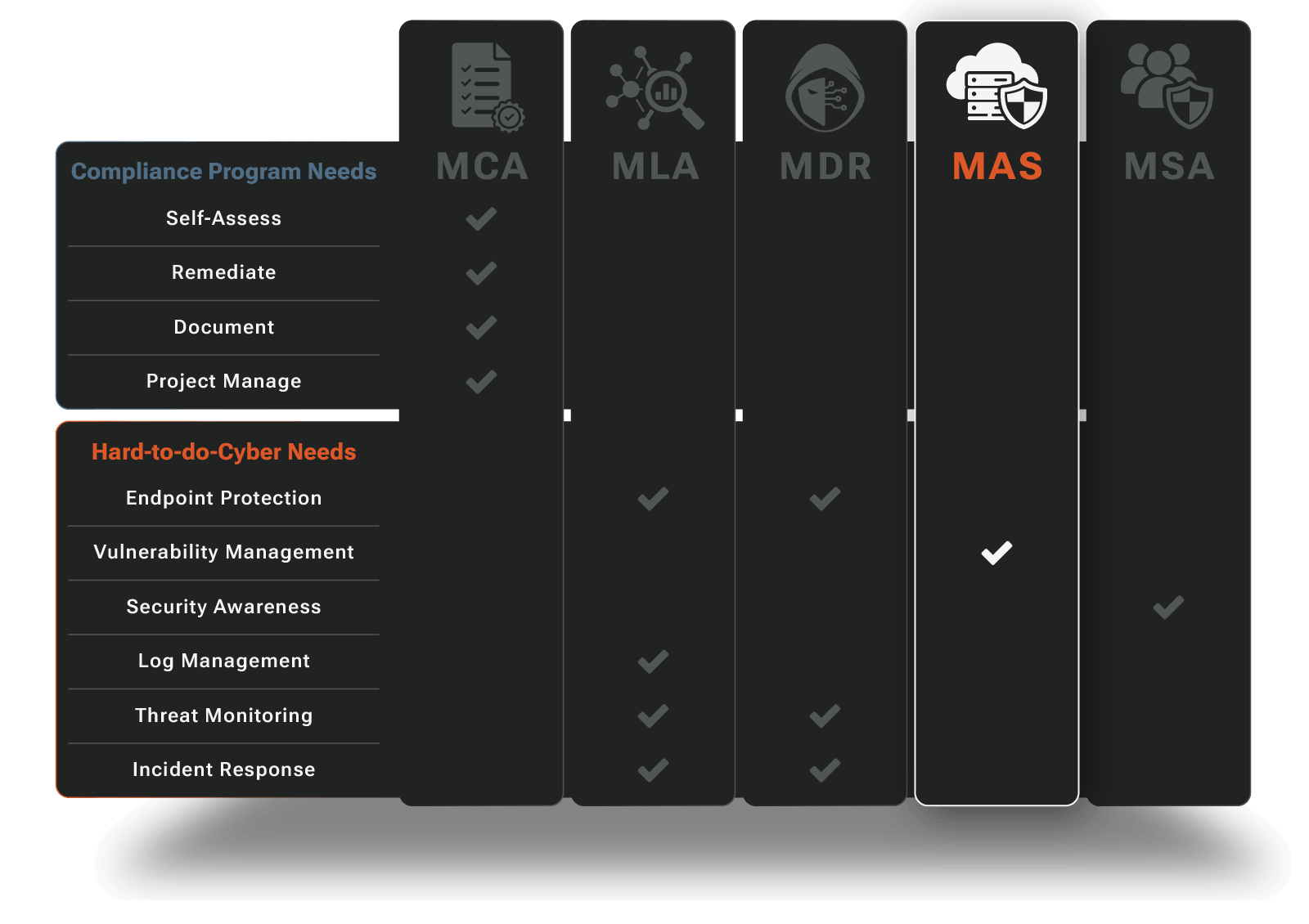
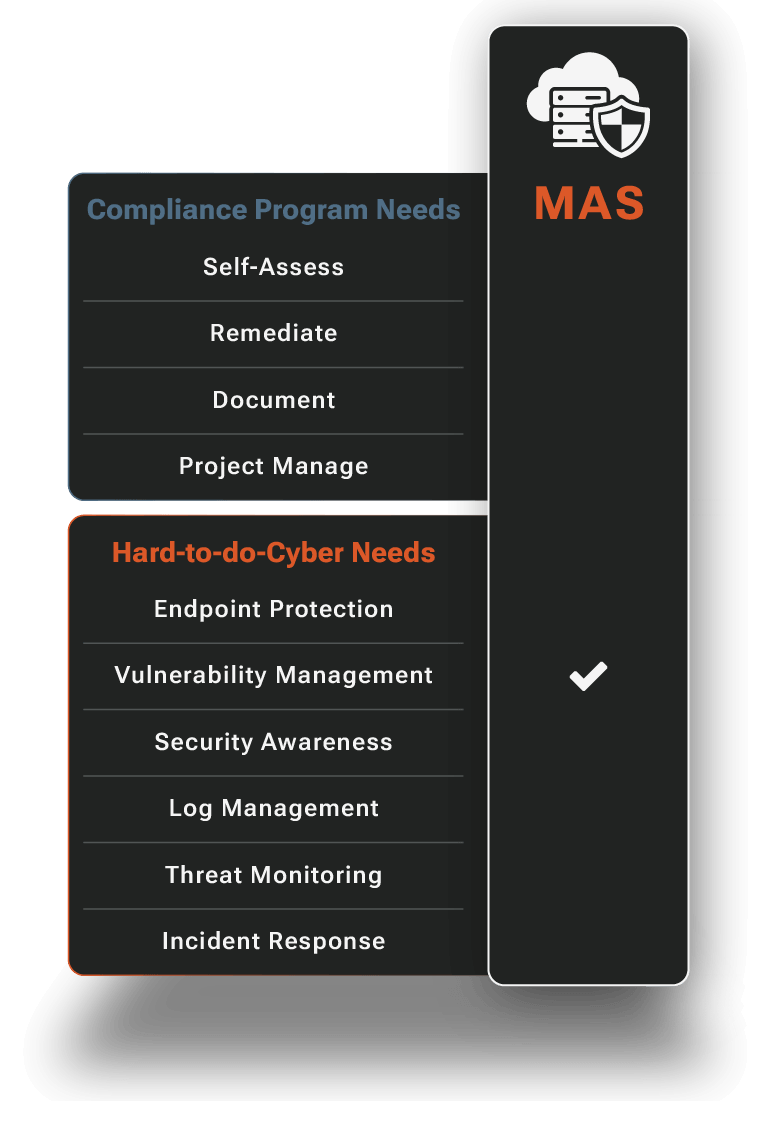
Managed Attack Surface
Threat actors leverage vulnerabilities to get a foot in the door and expand their presence. Our Managed Attack Surface offering persistently reduces your exposure so your organization becomes a much harder target for both opportunistic and targeted attacks.
- Endpoint and Server Vulnerabilities Detected and Prioritized
- Pragmatic and Manageable Remediation Pace
- Accelerated Critical Fix Response
- Expert Guidance and Collaboration With Your IT/MSP Partners
- Closed Loop “Fixed” Visibility
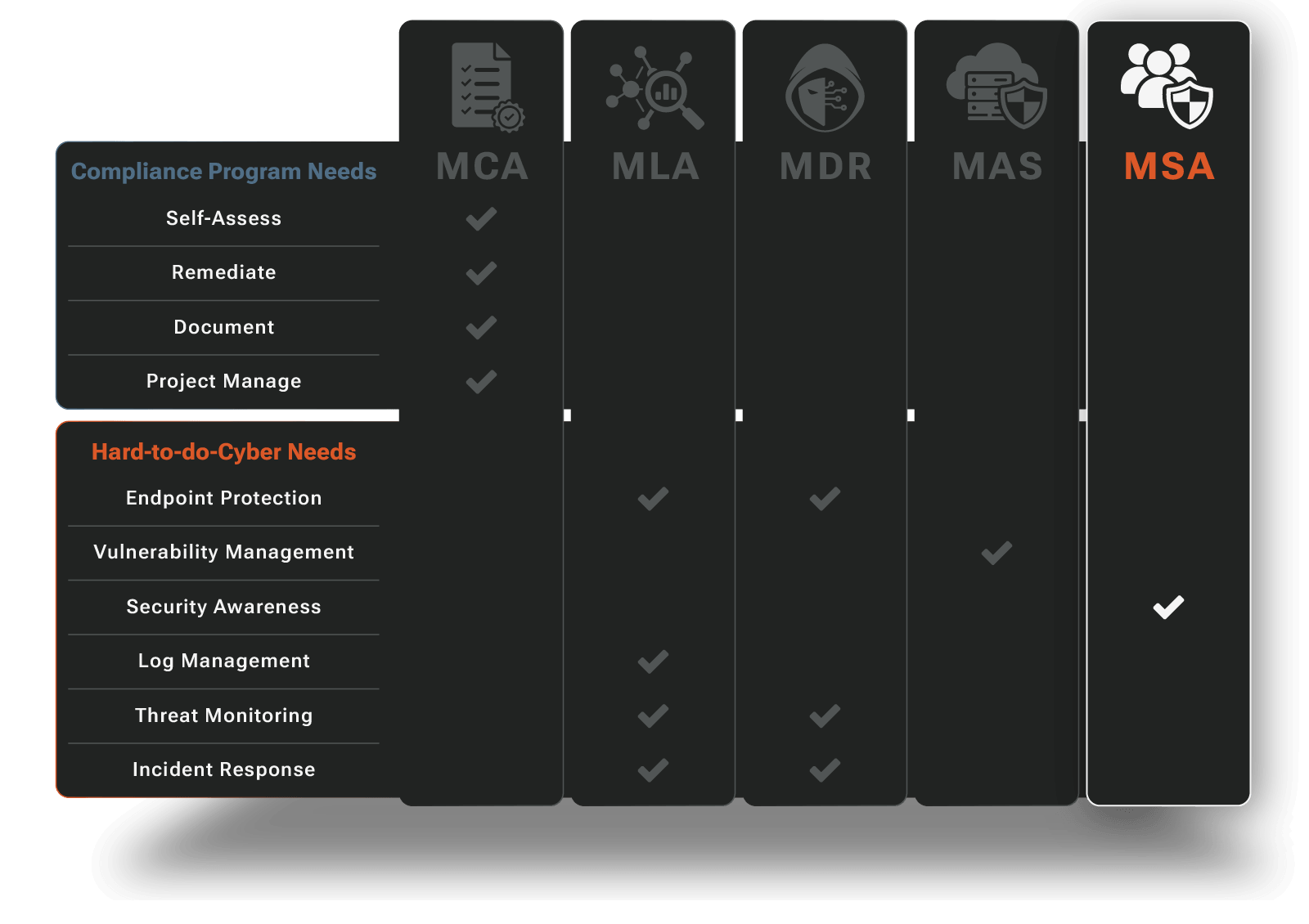
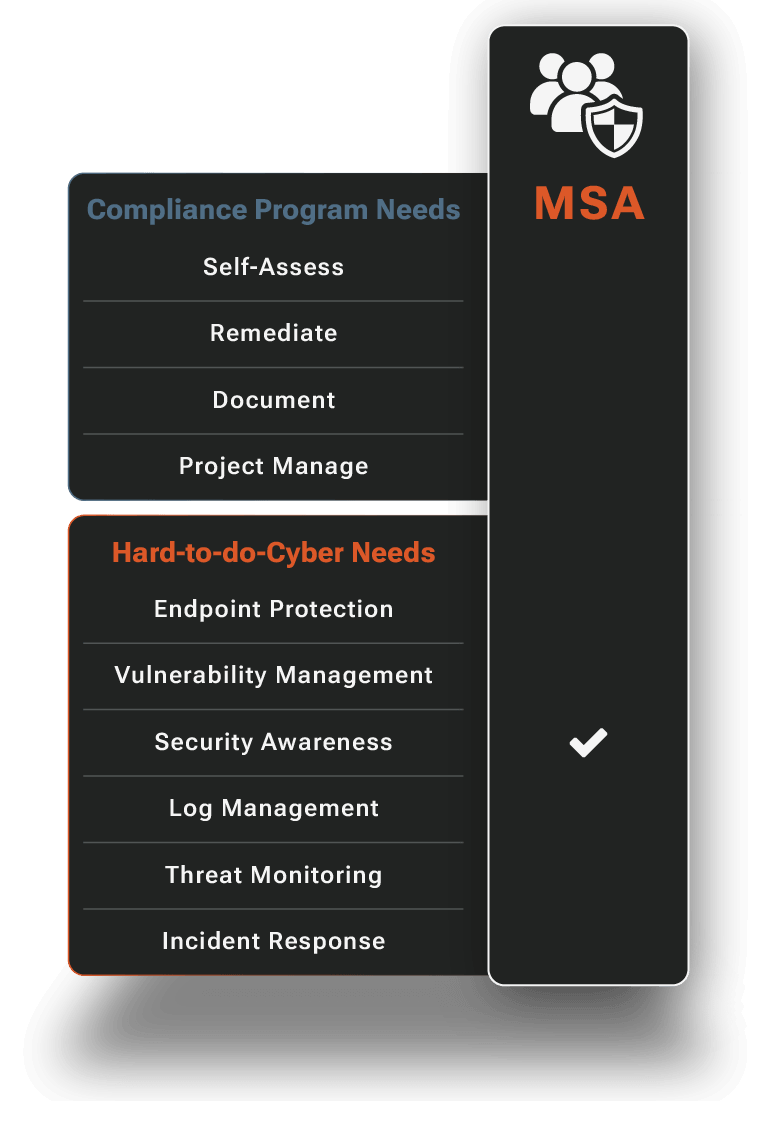
Managed Security Awareness
People are too often the weak link. We'll shore up your human line of defense with security awareness content, exercises and phishing simulations that’s informed by real threats our vSOC sees every day.
- Comprehensive Annual Training
- Ongoing “Bite Sized” Training
- Phishing Attack Simulations
- Ever Evolving Expert Content
- Security Awareness Posture Visibility
Get the Visibility You Deserve
At RADICL, operational transparency is a core value. We want you to know exactly what we are doing to keep you secure and compliant. As a customer, you should demand no less from a managed security services provider. Through transparency comes accountability and trust.
Our Protection Delivered Dashboard
Watch this video to learn how with RADICL, you'll enjoy real-time visibility into how we are:
RADICL Pricing
If you’re evaluating a managed SOC service, pricing typically depends on environment size, coverage scope, and required compliance support. We’ll help you scope the right level of coverage without overbuying.
Frequently Asked Questions
What cybersecurity frameworks apply to critical infrastructure (NIST 800-171 vs NIST CSF)?
Most critical infrastructure operators are working with some combination of NIST 800-171 (focused on protecting sensitive information in non-federal systems) and the NIST Cybersecurity Framework, or CSF (a broader risk-management framework covering Identify, Protect, Detect, Respond, and Recover). Depending on your sector, you may also be layering in requirements like NERC CIP or TSA security directives.
How does RADICL help us meet NIST log retention requirements?
RADICL provides fully-managed log collection, normalization, and searchable retention (1-year archive) through our Managed Log Analytics (MLA) solution. Rather than scrambling to piece together logs from disparate systems when an assessor asks, you get centralized, AI-assisted search that produces audit-ready evidence on demand. This is often the difference between passing and failing an assessment for operators who already have solid controls in place but can't readily prove it. Learn more about NIST compliance services.
Do resource-constrained infrastructure operators need a full SOC?
No. Building and staffing an internal SOC is expensive and difficult to sustain, especially for lean IT teams who are already stretched across uptime, compliance, and daily operations. RADICL's vSOC model gives you 24/7 monitoring, triage, and response capabilities without the overhead of hiring, training, and retaining a round-the-clock security team.
Can you work with our existing MSP without replacing them?
Yes. RADICL is designed to complement, not replace, your existing MSP or internal IT team. We handle the specialized security functions, like 24/7 detection, triage, and response coordination, and hand off precise remediation actions to your MSP or IT staff to execute. You keep the relationships and workflows you already have; we fill the security gap they weren't built to cover. See how we work with MSPs.
How do you handle legacy environments and operational technology (OT) that can’t be easily patched?
We recognize that many operational technology systems can't support standard endpoint agents without disrupting critical workflows. Rather than forcing a one-size-fits-all deployment, RADICL can establish monitoring and response at the IT/OT boundary, giving you visibility into the convergence zone where legacy and modern systems meet without requiring changes to the control systems themselves. This lets you gain coverage where it's safe to instrument while respecting operational constraints elsewhere.
What proof do we get for regulators and auditors?
With RADICL you get centralized, searchable log evidence, documented incident response outcomes, verified vulnerability remediation, and consolidated compliance reporting, all built to hold up under NIST, NERC CIP, or TSA directive scrutiny. Instead of assembling evidence manually before an audit, RADICL keeps this documentation current and accessible in-platform, so you're always audit-ready rather than audit-reactive.
How do you avoid overwhelming our lean IT team with alerts?
The RADICL autonomous vSOC handles triage before anything reaches your team. We filter out noise, confirm what's actually a threat, investigate impact, and only escalate confirmed, actionable findings, with clear next steps attached. As a result, your IT team gets precise remediation tasks to execute, instead of a flood of raw alerts to sort through themselves.
Can you help with incident response planning and tabletop testing?
Yes. Beyond 24/7 detection and response execution, RADICL supports incident response planning and tabletop exercises to help your team build muscle memory before a real incident occurs. This includes documented testing outcomes, which also serve as compliance evidence for frameworks that require demonstrated IR readiness.
How fast can we get monitoring and evidence workflows in place?
Timelines vary based on your environment's complexity, but RADICL is built to move faster than a traditional SOC build-out. Because we're not starting from scratch, with no hiring, no tool procurement, and no lengthy integration cycles, most operators can have core telemetry ingestion and evidence workflows operational in a matter of weeks, not months.
Are you only focused on defense contractors, or do you support other regulated industries?
While RADICL has deep experience in defense-adjacent compliance work like CMMC, our platform and vSOC model are built for any regulated industry facing similar pressures: proving compliance and protecting operational uptime with lean teams. Critical infrastructure operators, healthcare, financial services, and other regulated sectors all face the same core challenge, and RADICL's model is designed to fit your specific framework requirements.