




Ransomware Protection

Ransomware can disrupt operations and expose sensitive data. Protect your regulated business with RADICL’s Virtual Security Operations Center (vSOC)-guided managed cybersecurity.

RADICL helps detect, contain, investigate, and coordinate response before ransomware-related activity becomes a larger incident.

Talk to a Specialist Learn About Our Platform
Div Line_Desktop
Div Line_Mobile
Ransomware

What Is Ransomware?

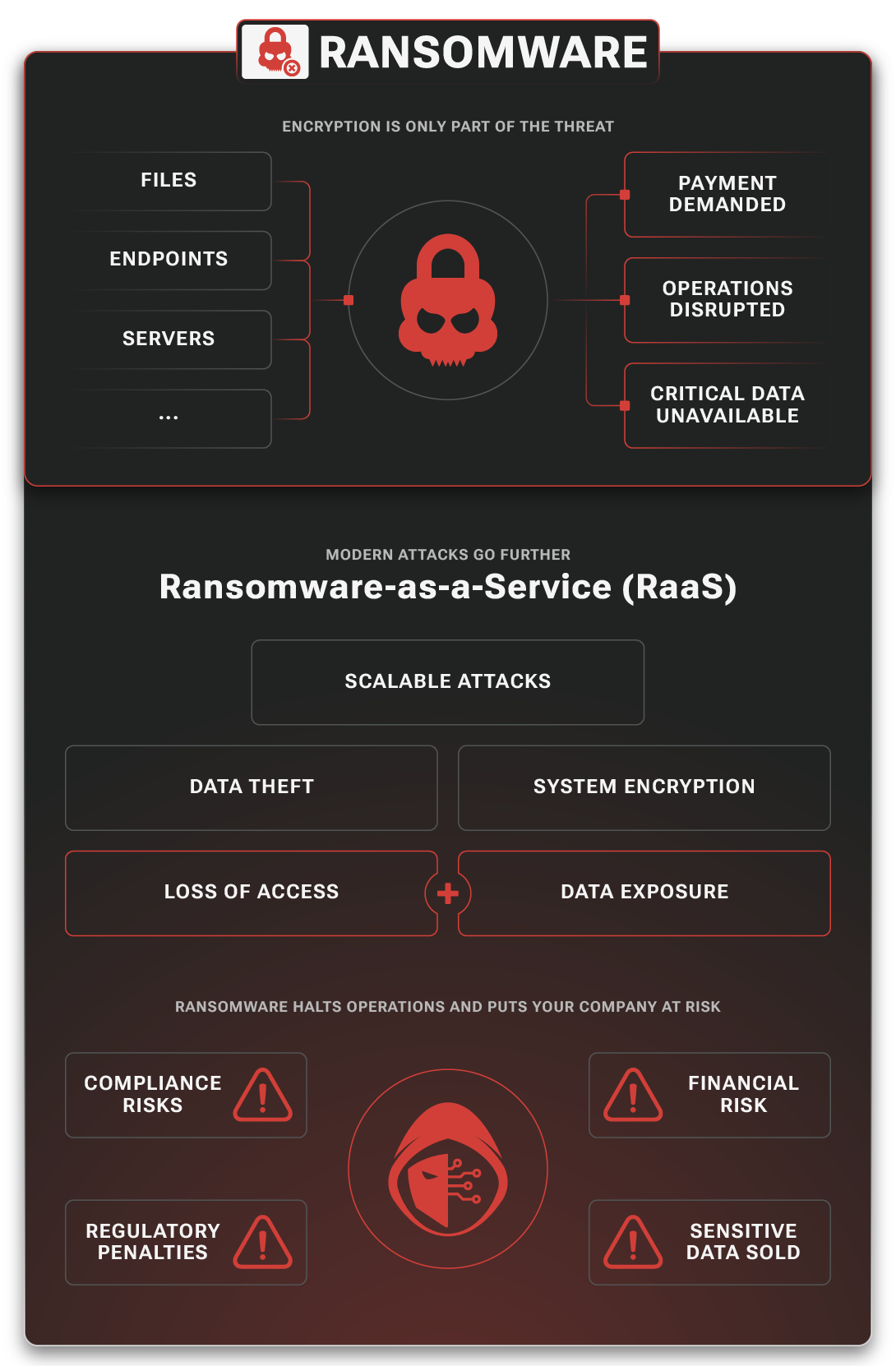
Ransomware is malicious software that encrypts files or systems. Threat actors use ransomware to demand payment in exchange for restoring access.

A successful ransomware attack can disrupt operations and prevent employees from accessing critical data.

Modern ransomware attacks often go beyond encryption. Many attackers use Ransomware-as-a-Service (RaaS) programs to scale their attacks. Some also steal sensitive information before encrypting systems.

This is known as double extortion ransomware. Attackers may threaten to publish or sell the data if the victim refuses to pay.

For regulated organizations, ransomware incidents can quickly turn into a broader data exposure concern. Intellectual property, Controlled Unclassified Information (CUI), or other sensitive business data may be at risk.

Ransomware

How Ransomware Infects Businesses

Ransomware can reach an organization through several common attack paths.

Phishing and Social Engineering

Phishing and Social Engineering

Fraudulent phishing emails are harder to spot. Threat actors use AI to mimic trusted entities, tricking employees into engaging with realistic messages and downloading malicious payloads.

This gives attackers an initial door into the organization, making ransomware protection increasingly critical.

Compromised Credentials and RDP

Compromised Credentials and RDP

Passwords regularly leak and appear on the dark web. Hackers use compromised credentials to access Remote Desktop Protocol (RDP), taking advantage of hybrid and remote work setups.

From there, lateral movement expands unauthorized access across the organization, enabling ransomware deployment.

Unpatched Vulnerabilities

Unpatched Vulnerabilities

Outdated software, unsupported systems, and unpatched vulnerabilities create opportunities for attackers to bypass normal access controls.

Threat actors can exploit known vulnerabilities to gain direct access to systems, deploy malware, and establish persistence within the environment.

Div Line_Desktop
Div Line_Mobile

Why Ransomware is an Existential Threat

The initial concern may focus on the ransom money itself, but ransomware’s real impact goes far beyond that payment.

If employees lose access to critical systems, projects stall and normal business activities may be disrupted for days or weeks. For businesses in highly regulated industries, the consequences can be even more significant.

If attackers gain access to CUI or other sensitive data, organizations may face compliance investigations and increased scrutiny from customers, partners, and assessors. This also puts organizations at risk of losing key DoD contracts and prime renewals.

Failed CMMC and NIST 800-171 audits also compound consequences as companies lose existing revenue and face fines.

How RADICL’s Defense-in-Depth Stops Ransomware

Train (MSA)

Train (MSA)

AI-enhanced phishing simulations help employees recognize and avoid the tactics most commonly used to deliver ransomware. By reducing the number of successful phishing attempts, organizations can close off one of the most common attack paths before attackers gain access.

Icon2-66

Detect (MDR)

Managed Detection and Response continuously monitors endpoint and network activity for signs of compromise. Suspicious behavior such as network discovery, privilege escalation, or lateral movement can be identified before ransomware is deployed.

Contain (vSOC)

Contain (vSOC)

When ransomware-related activity is detected, RADICL's human-led vSOC quickly isolates affected systems and prevents the threat from spreading across the environment.

24/7 Health Monitoring

Log (MLA)

Managed Log Analytics maintains a one-year, tamper-evident archive that helps investigators reconstruct attacker activity. This forensic evidence (required by regulators and C3PAO assessors) can support incident investigations, compliance reporting, and efforts to determine whether sensitive data or CUI was accessed.

Respond (vSOC)

Respond (vSOC)

RADICL's vSOC does more than just generate alerts. Analysts investigate threats, coordinate containment actions, and work alongside internal IT teams or MSPs to support remediation and recovery.

Icon2-68

Reinforce (MSA)

RADICL's Managed Security Awareness program doesn’t treat security awareness as a one-time event. It continuously reinforces employee education through training informed by the same vSOC analysts who respond to real-world threats every day.

Don't Wait for a Ransom Note

Ransomware protection starts before encryption. See how RADICL helps regulated organizations detect suspicious activity earlier, coordinate response, and strengthen compliance readiness.

Let’s talk now

Frequently Asked Questions

Should you pay the ransom?

Most cybersecurity and law enforcement organizations discourage paying ransomware demands, although the decision can be complicated.

Payment does not guarantee data recovery, prevent future extortion, or ensure stolen information will be deleted.

Organizations should focus on incident response, containment, recovery, and forensic investigation to determine the full scope of the attack.

What is Ransomware-as-a-Service?

RaaS is a criminal business model in which ransomware developers provide malware and attack infrastructure to affiliates in exchange for a share of ransom payments.

RaaS has lowered the barrier to entry for cybercriminals. It contributed to the growth of ransomware attacks against organizations of all sizes.

How does RADICL work with my MSP to stop ransomware?

RADICL works alongside MSPs by providing 24/7 monitoring and human-led vSOC support. The team also provides Managed Detection and Response and incident investigation capabilities.

RADICL helps identify and investigate potential threats, contain real ones and coordinate with the MSP responsible for day-to-day IT operations and remediation.