




Data Loss Prevention (DLP)

For regulated businesses, data loss means lost contracts, failed audits, and severe financial penalties. Learn how to protect your Controlled Unclassified Information (CUI) and Intellectual Property (IP) from exfiltration and insider threats.

Talk to a Specialist Learn About Our Platform
Div Line_Desktop
Div Line_Mobile
Data Loss Prevention

What Is Data Loss Prevention (DLP)?

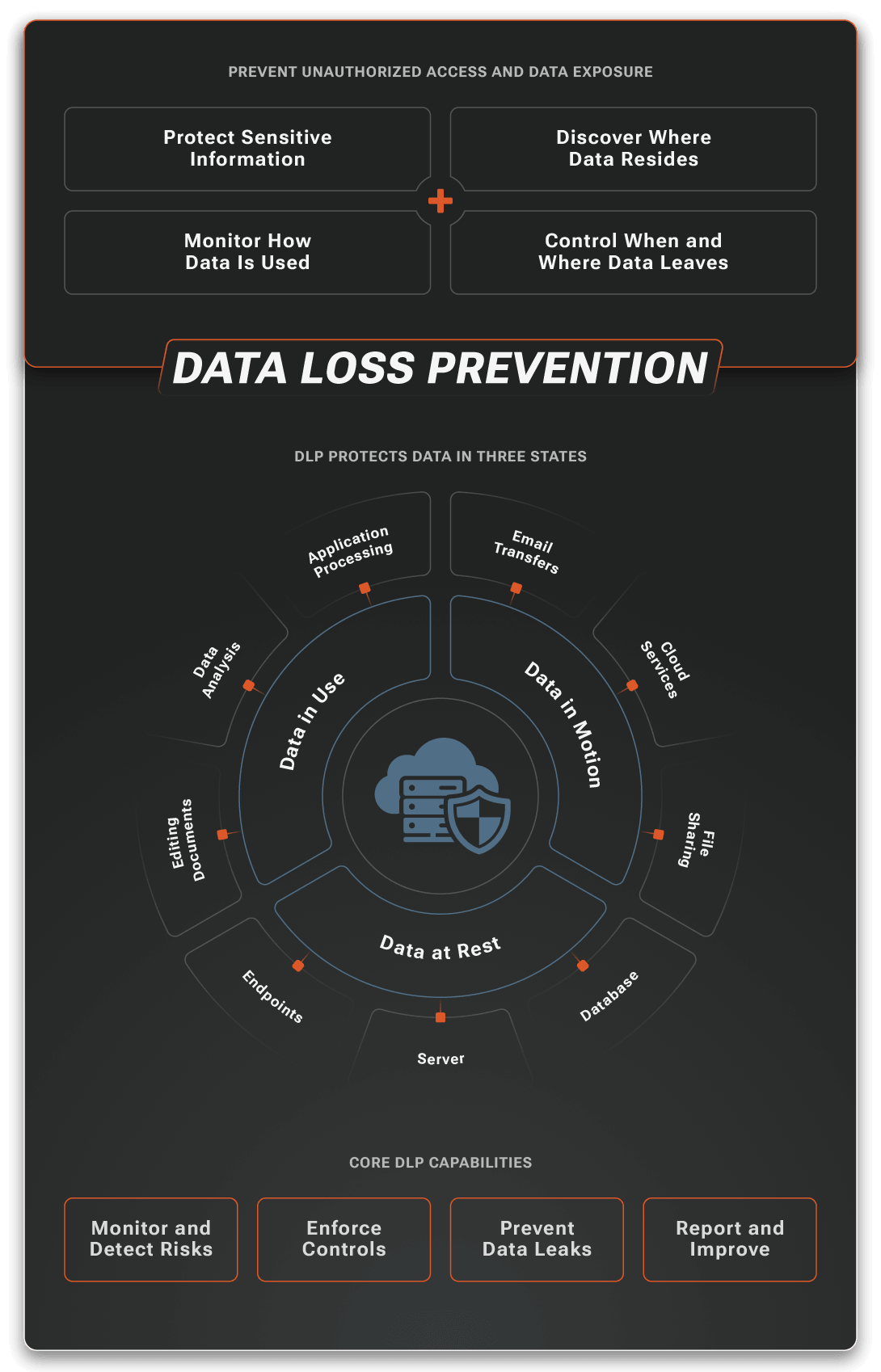
Data Loss Prevention (DLP) is a set of processes and technologies that protect sensitive information from unauthorized access, misuse, or accidental exposure. Effective DLP helps organizations understand where sensitive data resides, how it is used, and when it leaves the organization.

DLP protects data in three states:

  • Data in Use: Information actively being accessed, processed, or modified by users or applications.
  • Data in Motion: Information moving across networks, email, cloud services, or file-sharing platforms.
  • Data at Rest: Information stored on endpoints, servers, databases, or cloud repositories.
Data Loss Prevention

How Does Data
Leakage and Exfiltration Happen?

Sensitive data can leave an organization through cyberattacks, user mishandling, or even simple everyday mistakes.

Malicious Exfiltration

Malicious Exfiltration

Attackers, including nation-state-affiliated threats, steal IP, CUI, or other sensitive data before deploying ransomware or selling ill-gotten information.
Unpatched Vulnerabilities

Negligence & Misconfiguration

Sensitive files are exposed through user error, misconfigured cloud storage, or unauthorized file sharing.

Compromised Credentials and RDP

Insider Threats

Employees or contractors intentionally or unintentionally move sensitive data outside approved systems using their legitimate access.
The Problem With Legacy DLP Software

Traditional DLP tools often require extensive policy creation, data classification, and ongoing rule management before they provide value. For lean IT teams and organizations working with cybersecurity for MSPs, managing a standalone DLP platform can become a significant operational burden.

The result is a system that generates alerts but still requires time, expertise, and constant tuning to separate real risks from false positives.

Div Line_Desktop
Div Line_Mobile

How RADICL Prevents Data Loss

RADICL takes a multi-pronged approach to keeping data secure, reducing audit risk, and minimizing administrative burden.

Icon2-66

Stop Exfiltration (MDR)

Managed Detection and Response (MDR) continuously monitors endpoint and network activity across your environment, instantly detecting and helping prevent data exfiltration attempts from malware, compromised accounts, or active threat actors before damage occurs.

24/7 Health Monitoring

Track Access & Prove Compliance (MLA)

Managed Log Analytics (MLA) centralizes security logs across your environment to track access and detect insider threats or compromised accounts touching sensitive data. RADICL maintains a one-year tamper-evident archive to support audits, investigations, and compliance.

Contain (vSOC)

Human-Led Containment (vSOC)

When suspicious data movement is detected, RADICL's AI-powered Virtual Security Operations Center (vSOC) investigates the threat in real time and isolates affected endpoints or identities, containing the incident and helping stop data loss before it spreads.

Data Protection for CMMC, NIST, and HIPAA

Security frameworks expect organizations to demonstrate, not just document, how they protect sensitive data, including the:

  • Cybersecurity Maturity Model Certification (CMMC)
  • National Institute of Standards and Technology's (NIST) 800-171
  • Health Insurance Portability and Accountability Act (HIPAA)

Organizations need operational controls that monitor access, detect unauthorized activity, and maintain audit-ready evidence, such as AU (Audit and Accountability) and IR (Incident Response) controls in NIST 800-171.

Protect Your Data. Grow Your Business.

Protect sensitive information with continuous monitoring backed by RADICL's human-led security team.

Let’s talk now

Frequently Asked Questions

What is the difference between data leakage and data exfiltration?

Data leakage is the unintentional exposure of sensitive information, often caused by human error or misconfigured systems. Data exfiltration is the deliberate theft or unauthorized transfer of data by cybercriminals, malicious insiders, or compromised accounts.

Does RADICL replace traditional DLP software?

RADICL complements or, in some cases, reduces the need for traditional DLP software. It combines MDR, MLA, and a human-led vSOC to detect and investigate suspicious data movement and support compliance. The right approach depends on your organization's security and regulatory requirements.

How does data protection impact CMMC Level 2?

CMMC Level 2 requires organizations to protect CUI and demonstrate that security controls are operating effectively. Be prepared for these assessments by monitoring data access, detecting unauthorized activity, and maintaining audit-ready evidence.