
by Jordan Dean on Sep 29, 2026

With the midterm elections coming up, you've probably seen the ads: “Check your voter registration in 30 seconds!” It's good advice, to be fair. Registration problems like a purged record, an old address, or a typo in your name are easier to fix now than at the polling place on Election Day.
But before you type your name, birthday, and home address into the first site that pops up in your feed, it's worth asking a couple of questions: who runs this website, and what are they doing with my information?
Checking your registration should be boring; a few clicks, a quick confirmation, and you move on. But what if those same clicks are exposing more about you than you realize?
Your Registration Check is Valuable Data
Political campaigns and advocacy groups run on data: knowing who you are, where you live, whether you're registered, and whether you're likely to vote is enormously valuable to anyone trying to persuade, mobilize, or advertise to you. A registration lookup tool is an efficient way to collect all of that info at once. You hand over the details voluntarily, because you think you're doing your civic duty.
That doesn't make every third-party voter tool sinister, though. Groups across the political spectrum, partisan and nonpartisan, build these tools, and many are upfront about wanting to contact you later. The problem is that the difference between a site that simply checks your status and one that turns your visit into a marketing profile is usually buried in a privacy policy almost nobody reads.
A Case Study: votesafe.org
A recent example shows how far this can go. Reporting from the newsletter Popular Information examined votesafe.org, a registration-check site run by America PAC. The super PAC is funded by Elon Musk, and the reporting was also amplified by election law scholar Rick Hasen’s Election Law Blog. The site has been promoted through an aggressive ad campaign in key states, spending more than $180,000 on Meta ads in a single week.
According to that reporting, votesafe.org collects your full name, date of birth, home address, email, and cell phone number, along with your IP address and approximate location, details about your device and browser, and a record of every page you view and link you click. That’s an extraordinary amount of personal information to hand over just to check your voter registration. The registration status it shows you reportedly comes from a voter file held by the PAC or its vendors, not directly from your state's official records.
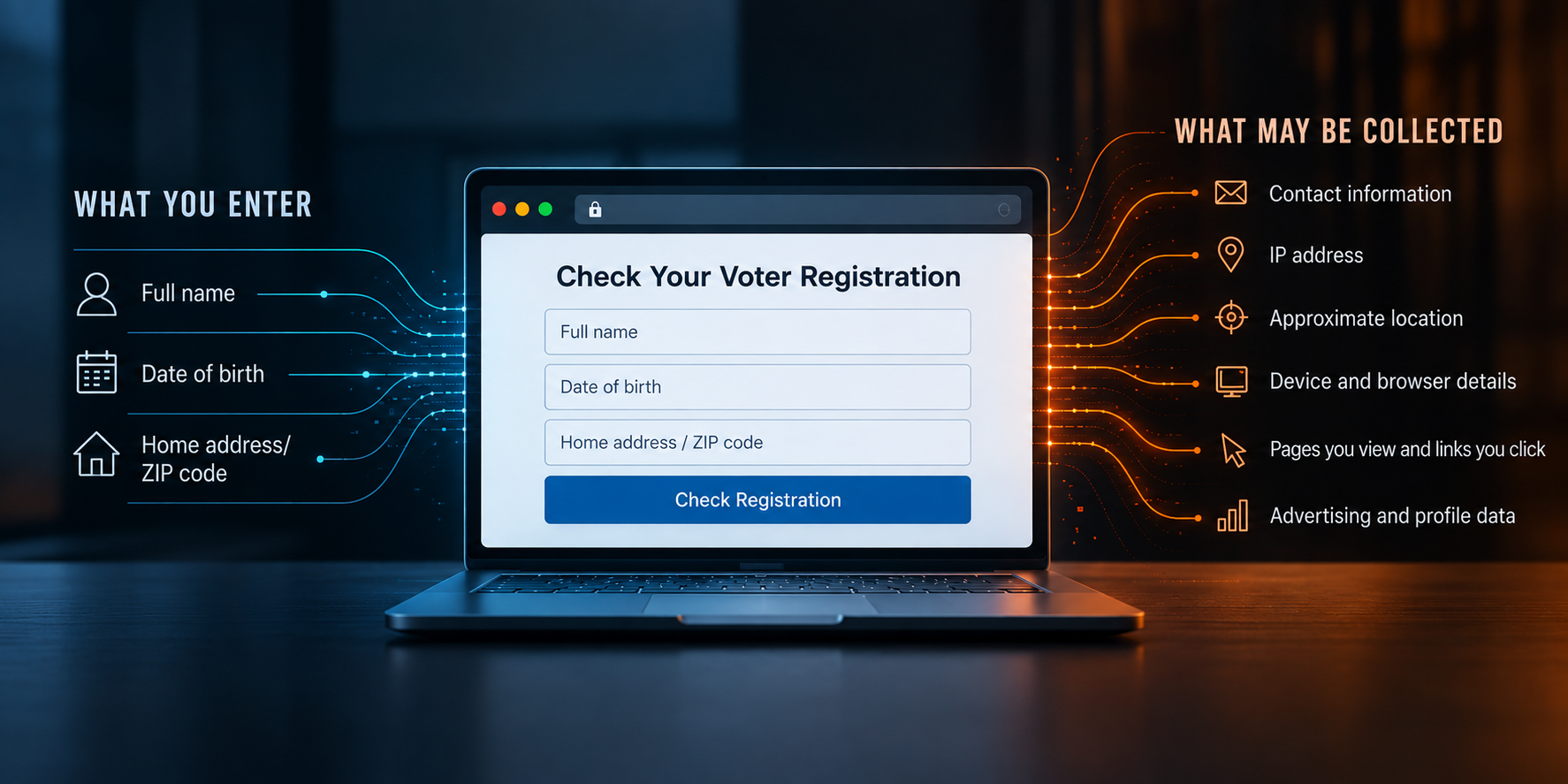
What happens next is an even bigger issue. The site's earlier privacy policy promised that personal information would stay with America PAC and wouldn't be shared with advertisers or outside groups. However, the updated policy allows the PAC to share or sell personal information to business partners, including whether you're registered and how you vote, where the law permits. It also allows the sale of inferences drawn from your data about things like your psychological tendencies, attitudes, and aptitudes. Users also agree to receive calls and texts from third parties, not just the PAC.
The reporting also found the site passing visitor data to a list of companies: address and contact details to Facebook and Google for ad matching, a hashed email to the ad firm The Trade Desk to track users across websites, apps, and streaming TV, usage data to X (formerly Twitter), and email addresses to a marketing platform. It also creates a device "fingerprint" designed to keep identifying you even if you clear your cookies.
To be clear, none of this is hidden in the legal sense. It's disclosed in a privacy policy. But a disclosure that most visitors will never see isn't meaningful consent, and very few people who click an ad to check their registration expect to be enrolled in a cross-platform advertising profile.
The Official Option Collects Almost Nothing
Compare that with vote.gov, the federal government's registration portal, run by the Election Assistance Commission (EAC). According to its privacy policy, the EAC doesn't collect personally identifiable information from visitors unless they choose to provide it (for example, by emailing the agency), and its cookies don't store anything that identifies you. Vote.gov doesn't even check your registration itself. It simply sends you to your state's official election website, which is where your actual record lives.
That's the key point: the authoritative answer to "Am I registered?" comes from your state or local election office. Any other site is showing you a copy, and possibly an outdated one.
How to Check Your Registration Safely
Start at the source. Go to vote.gov or type your state election office's address yourself, which is usually the site managed by your Secretary of State. Official state election sites almost always end in .gov.
Don't trust the ad, trust the URL. Names like "safe," "official," or "verify" don't mean anything. Before entering information, look at the web address and scroll to the bottom of the page to see who runs the site. Political committees are generally required to include a "paid for by" disclaimer.
Skim the privacy policy for a few key words. You don't have to read the whole thing. Search the page for "sell," "share," "partners," and "third parties." If the policy allows your data to be sold or passed along, assume it will be.
Give only what's required. An official lookup typically needs your name, date of birth, and maybe your county or ZIP code. If a site demands your cell phone number and email just to check your status, that's a sign the check isn't the main point.
Watch for texting consent. Many sites bury permission to text and call you in the fine print. If you've already used one, you can usually reply STOP to end the messages.
If you already used a third-party site, don't panic. Confirm your status on your official state site, and check whether the organization offers a way to request deletion of your data. Some states give residents legal rights to do this.
Your Vote is Private, Your Data Should Be Too
Registering and checking your status are basic parts of participating in a democracy. They shouldn't come with a hidden price tag. Before you click that ad, take 10 extra seconds to go to the source. Your election office will tell you everything you need to know, and it won't sell the answer to anyone.
Your Data Is Only as Safe as the Systems That Hold It
The same tactics that turn a simple voter lookup into a data harvest (tracking pixels, device fingerprinting, and automated data sharing) are also used against businesses every day. For small and mid-sized companies, especially those supporting defense and critical infrastructure, one exposed login or overlooked vulnerability can put customer data, contracts, and compliance at risk. That makes knowing where your business is exposed, and protecting those weak points, just as important as knowing who has access to your personal data.
RADICL gives growing businesses enterprise-grade protection without building a security team from scratch. Its virtual security operations center pairs AI-driven monitoring with human experts to provide 24/7 threat detection and response, attack surface hardening, and compliance support, all as a single managed service.
Your information is valuable. Knowing who you trust with it is one of the first steps in protecting it, both personally and professionally.

Volt Typhoon: The Threat Hiding in Plain Sight

Best MDR Providers for Regulated Industry & DIB Contractors (2026)


No Comments Yet
Let us know what you think