
by Jordan Dean on Sep 23, 2026

If your company sells cloud-based software or services to the U.S. federal government, or hopes to, you'll eventually run into FedRAMP. It's one of the most important, and most misunderstood, compliance frameworks in the federal contracting world.
Here's a plain-language breakdown of what it is, why it matters, and what it takes to get authorized.
FedRAMP, Defined
FedRAMP stands for the Federal Risk and Authorization Management Program. It's a government-wide program that standardizes how cloud products and services are security-tested, authorized, and monitored before federal agencies are allowed to use them.
Rather than having each agency run its own security review of every cloud vendor, FedRAMP creates a "do it once, use it everywhere" model: a cloud service provider (CSP) goes through one rigorous assessment, and any federal agency can then rely on that same authorization.
The program exists because federal agencies are required under the Federal Information Security Management Act (FISMA) to meet baseline cybersecurity standards for their information systems. FedRAMP applies that same underlying logic specifically to cloud computing.
Why It Matters to Government Contractors
If you're a government contractor, FedRAMP authorization matters to you. This includes defense contractors, research firms, systems integrators, and SaaS companies trying to break into the federal market. Whether you need to become FedRAMP authorized yourself or simply need to work with an authorized cloud provider, it's often not optional.
Federal agencies are generally required to use FedRAMP-authorized cloud services for deployments at the Low, Moderate, or High risk-impact levels. That means if your product touches federal data or runs on federal infrastructure, your agency customer will likely ask about your FedRAMP status before they'll sign a contract.
Beyond federal agencies themselves, several other groups have strong reasons to care:
- Defense Industrial Base (DIB) companies handling sensitive but unclassified information often need FedRAMP-authorized infrastructure to meet their own contractual security obligations.
- State and local governments, while not formally bound by FedRAMP, increasingly lean on it (or its cousin, StateRAMP) as a trusted security benchmark.
- Universities and research institutions receiving federal grant funding may need FedRAMP-authorized tools for projects involving sensitive data.
- Healthcare organizations subject to federal regulations sometimes adopt FedRAMP-authorized services as part of their broader risk management approach.
What FedRAMP Authorization Actually Involves
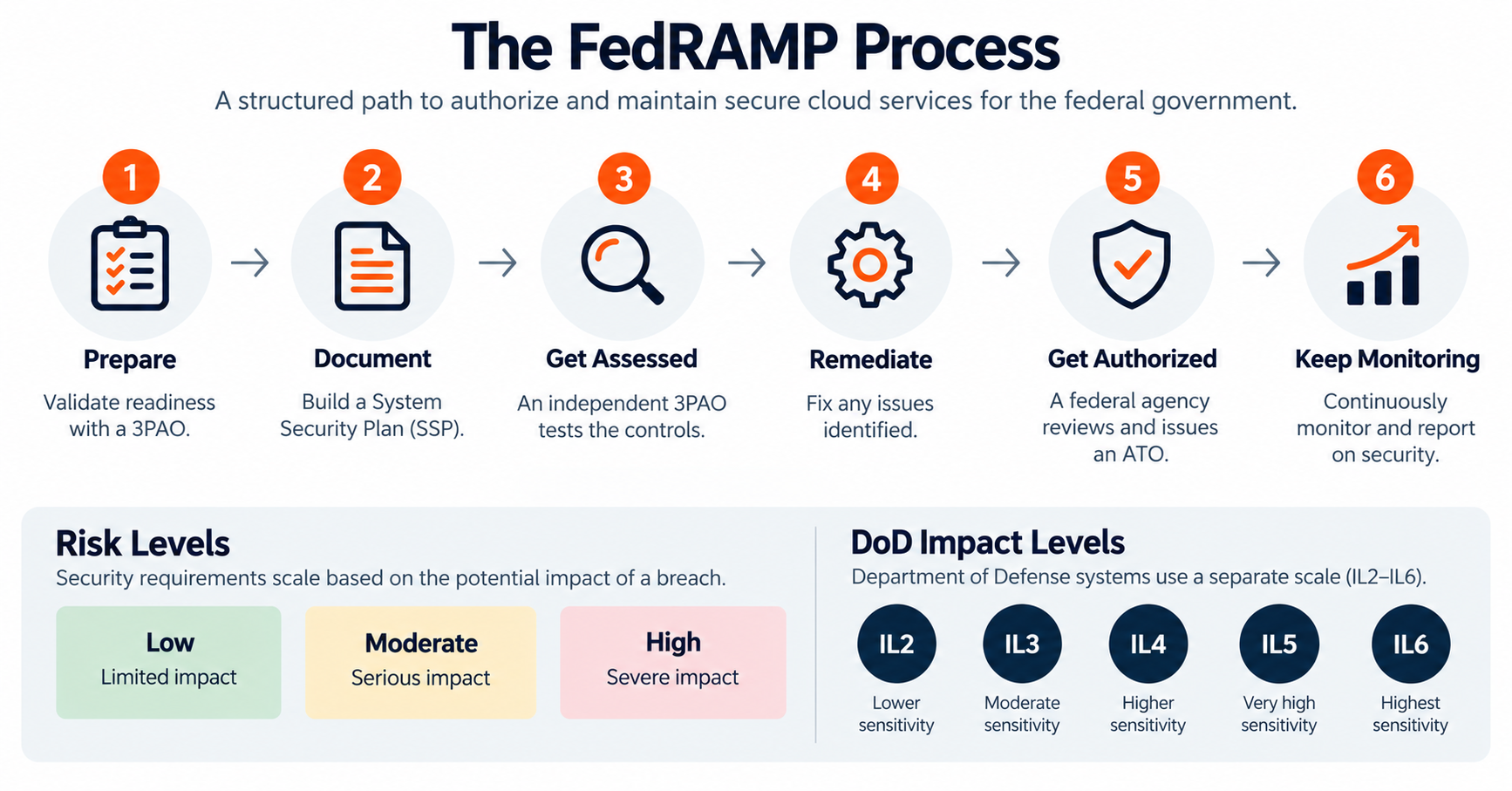
At its core, FedRAMP is built on the NIST Risk Management Framework, a structured process for identifying and managing cybersecurity risk in federal systems. The path to authorization generally follows these stages:
- Readiness assessment: A cloud provider works with an accredited Third-Party Assessment Organization (3PAO) to demonstrate that it's prepared for a full review, earning "FedRAMP Ready" status.
- System Security Plan (SSP): The provider documents exactly how required security controls are built into its system.
- Security assessment: The 3PAO independently tests the system against those controls and produces a Security Assessment Report.
- Remediation: The provider fixes any weaknesses the assessment turns up.
- Authorization decision: A federal agency (or, historically, the Joint Authorization Board) reviews the full package and issues an Authority to Operate (ATO) or Provisional ATO, officially making the provider "FedRAMP Authorized."
- Continuous monitoring: Even after authorization, providers must keep monitoring and reporting on their security posture.
Security requirements scale with risk. Systems are categorized as Low, Moderate, or High impact based on how damaging a breach would be, and Department of Defense systems layer on their own Impact Level (IL2 through IL6) scale for handling controlled unclassified or classified information.
FedRAMP Is Being Modernized Right Now
It's worth knowing that FedRAMP is in the middle of a significant overhaul. In early 2025, the program launched a pilot called FedRAMP 20x, designed to fix long-standing complaints that the traditional process was too slow, too manual, and too expensive for smaller companies to pursue. The effort was propelled by the FedRAMP Authorization Act and an accompanying White House policy memo directing agencies to modernize the program.
Instead of lengthy narrative documentation, FedRAMP 20x relies on Key Security Indicators (KSIs) — specific, automatable checks (like verifying a particular encryption standard is in use) that can be validated continuously rather than reviewed by hand once a year. Early pilot participants reportedly reached full authorization in as little as three months, compared to 18 or more months under the traditional process, according to a 2026 analysis.
As of mid-2026, this modernization has moved well past the pilot stage. FedRAMP finalized a package called the Consolidated Rules for 2026 (CR26) in June 2026, merging the automated FedRAMP 20x model with revised requirements for existing traditional authorization holders into one unified ruleset. Optional early adoption began in early July 2026, with mandatory adoption for all stakeholders required by January 1, 2027.
Two pathways currently coexist: the traditional Rev5 path, which relies on NIST SP 800-53 Revision 5 controls and requires agency sponsorship and manual documentation review, and the modernized 20x path, which skips agency sponsorship and leans on automated validation.
One notable shift for contractors to watch: the familiar Low/Moderate/High impact labels are being phased out in favor of a lettered "certification class" system (A through D). Vendors and contracting officers alike will need to get comfortable with this new vocabulary over the next year.
The Bottom Line for Contractors
For government contractors, the practical takeaway is this: FedRAMP authorization signals to federal buyers that a cloud product has been independently vetted against a consistent, government-wide security bar. Using a FedRAMP-authorized provider (or becoming one) saves agencies from re-inventing security reviews for every vendor, and it saves contractors from having to prove their security posture to every individual customer.
If you're evaluating cloud vendors for a federal contract, the FedRAMP Marketplace lets you check a provider's status (Authorized, In Process, or Ready) along with which agency sponsored the authorization. If you're a vendor pursuing authorization yourself, given the pace of change right now, it's worth talking to a 3PAO or FedRAMP advisor about whether the traditional Rev5 path or the newer 20x/CR26 path makes more sense for your product and timeline.
Navigating Compliance? RADICL Can Help
FedRAMP is just one piece of the federal compliance puzzle. Government contractors and companies in the Defense Industrial Base are also facing CMMC and NIST 800-171 requirements, and juggling multiple frameworks with a small team can quickly become overwhelming.
RADICL helps government contractors get and stay audit-ready. The platform pairs 24/7 threat monitoring, security training, and managed security operations with hands-on compliance guidance. This helps contractors prove their controls are actually working, not just checked off in a spreadsheet, while keeping their contracts protected.
Talk to a RADICL specialist today to simplify your compliance journey.

What is DFARS 252.204-7012? A Guide for Defense Contractors

FAR CUI Rule vs. CMMC: What Government Contractors Need to Know

No Comments Yet
Let us know what you think